SUPPORT THE NEW TOURNEMIRE DOCUMENTARY
Produced by Fugue State Films.
Learn More Here
9: L’Orgue Mystique

On the fourth of January 1927, Tournemire played for the marriage of his student, Joseph Bonnet, and at the wedding, he announced in the presence of Dom Joseph Gajard (choirmaster at the Solesmes Abbey) and Louis Vierne that he would begin work on what was then termed L’Orgue Glorieux, something Bonnet had long been advocating.
Spurred on by the technological and tonal advances of the nineteenth-century organ-builder Aristide Cavaillé-Coll, Paris saw the rise of the Messe basse pour orgue, a peculiarly French invention where the Grand Orgue made liturgical cantillations within the Mass in lieu of a choir. While popular, the disconnect between the altar and the organ (or indeed the adversarial relationship between the two) became notorious—the event essentially becoming an organ concert where a Mass just happened to be taking place. L’Orgue Mystique, through its liturgical sensitivity, would challenge this concert ethos, rendering a musical beau idéal purely ad majorem Dei gloriam.
Hoping to elevate the Mass to its full theological musical grandeur, Bonnet, seeking to enkindle the flame of inspiration, had gifted Tournemire with Dom Guéranger’s magnum tome, L’Année liturgique, which ultimately would serve as a liturgical and theological guide for what Tournemire initially called L’Orgue Glorieux. After Bonnet’s wedding, having found his muse, Tournemire organised the chants to be cited in a grand plan using the 1922 Paroissien romain edition of the Liber Usualis and the 1897 edition of the Liber Antiphonarius as musical sources. His modus operandi was to begin with the feast days, establishing the work’s soteriological emphasis by starting with Easter Day—which Tournemire termed “a sun that shines around him a multitude of worlds”—completing this Office on the eleventh of November 1927. Upon the composition of the final feast day (All Saints) on the sixteenth of March 1928, Tournemire renamed the work L’Orgue Mystique. Then, composing the rest of the year in liturgical sequence, he finished the last Office on the fifth of February 1932. Consisting of over a thousand pages of printed music (frontispieces, forewords, et cetera, making the final page tally around thirteen hundred), the score took a gruelling eight years for the publisher Heugel to complete. In the Foreword to L’Orgue Mystique, Bonnet wrote:
A great musician was needed for its accomplishment, a master of organ technique and composition, having a great Spirit of Faith, loving the supernatural beauty of the Liturgy and of Gregorian melodies, a disciple of J. S. Bach and his Latin forerunners who created for Gregorian themes different forms that the Great Cantor resumed in the chorale preludes. This great musician had to work in peace and meditation as an artist must do. It is a splendid evocation of the architecture of our cathedrals, of the rich colour of their stained glass, of liturgical splendour revealed to us in the Monastery of Solesmes as we would like to find in every church of the Catholic world. Our modern musical writing is extraordinarily fit to adorn the Gregorian melodies. [Alternate translation: Our contemporary musical language possesses astonishing aptitudes to paraphrase Gregorian melodies eternally young.] So without sacrificing anything of his rich imagination, through his brilliant originality, Charles Tournemire has succeeded in creating such a mystical frame for the liturgical melodies.
In losing the Organ Professorship to Dupré, Tournemire would surpass Dupré in musical achievement through L’Orgue Mystique, both in substance and scope.
Bibliotheque Nationale de France
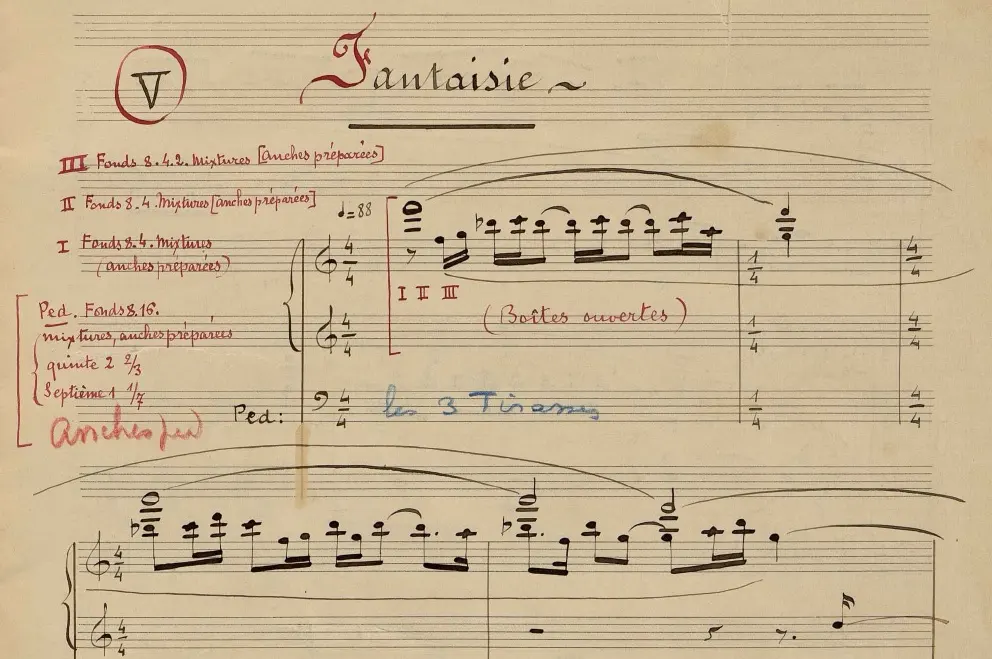
“L’Orgue mystique. 51 offices de l’année liturgique inspirés du chant grégorien et librement paraphrasés, Charles Tournemire, op. 55–57]” (manuscrit autographe)

Each of the fifty-one volumes of L’Orgue Mystique consists of five movements to be offered during the Grand messe:
Prélude à l’introït
This movement is based upon the Introit chant; however, despite popular misconception, it is not the initial processional music accompanying the entrance of the clergy into the sanctuary. It is meant to be played after the Asperges me or Vidi aquam (when the priest anoints the congregants with Holy Water) as the priest returns to the altar and thereby performs the role of a “chorale-prelude” to the Introit. (Because of the liturgical requirements, this movement is omitted in the Office for Holy Saturday.)
Offertoire
Based upon the Offertory chant, this movement is to be played after the chant is sung by the choir. Originally, Tournemire was going to base this movement on the Gradual or Alleluia, but eventually deferred to the liturgical Offertory. As this is done, the following is performed by the celebrant and deacons submissa voce: The recitation of the Offertory verse, the offering of the Host (Suscipe, sancte Pater, Deus, qui humanæ substantiæ, Offerimus tibi, In spiritu humilitatis, and Veni, sanctificator), the incensation, the Lavabo, the Prayer to the Holy Trinity (Suscipe, sancta, Trinitas), and the Secret.
Élévation
Tournemire originally was going to have this chant based upon the Offertory; however, he decided to base this movement upon a Benedictus or Magnificat antiphon for that day. This piece is to be played during the Canon following the Verba Testamenti. Tournemire himself preferred silence during the actual moment of Consecration. (This movement is also omitted in the Holy Saturday Office.)
Communion
Following Parisian custom, this movement is to be played during the distribution of Communion prior to the singing of the antiphon that concludes the Sacrament.
Pièce terminale
This concluding movement is based upon a hymn, the Gradual, the Alleluia, an antiphon (et cetera) for that liturgical day and is to be played as the sortie during the submissa voce reading of the Last Gospel (which usually is from the Johannine Prologue) and the recession of the clergy.
Stylistically, Tournemire’s musical impetus had a nineteenth-century French symphonic organ foundation while being infused with Post-Romantic and Impressionistic elements—his ardent faith finding its voice through the language of Gregorian Chant. Over three hundred chants are incorporated into the two hundred fifty-three movements of L’Orgue Mystique. What is more, his Symbolist semiotic approach made each composition a musical exegesis based upon the chant libretto. He frequently used the term paraphrase, which refers not merely to the musical rendering of a cantus firmus but to the piece’s theological hermeneutic. In fact, he called the Pièce terminale a résumé or a compilation of thoughts for each feast; hence, it is not simply Tournemire’s musical exploitation of chant that makes L’Orgue Mystique significant, but rather it was the theological elucidations that Tournemire evinced through chant combined with his ability to educe within the heart of the listener the latent human intuitive ken of the Divine through his art that makes it a monumental pinnacle of sacred music.
Prima facie, L’Orgue Mystique sounds like an improvisational dithyramb conjured in the nonce; yet in truth, this chef-d’œuvre exhibits Tournemire’s Franckian Post-Romantic structurally nuanced approach, where thematic reiterations are adroitly transmogrified through Beethovian deductive cyclic techniques. Whilst utilising such traditional styles as fantasias, toccatas, chorales, and fugues, and being rooted in the Gregorian tradition, L’Orgue Mystique is hardly an atavistic expression of antediluvian musical archaicism, for he bedighted these ancient formulæ in modern vêtement or, as Stephen Schloesser termed it, a futural past. Foregoing key signatures, in addition to the Occidental modes, Tournemire employed extreme chromaticism and musically heterodox Octatonic and Carnatic scales, thus serving as a bellwether for Messiaen (with whom he enjoyed a philosophical propinquity). In superimposing Gregorian monody and organum over diaphanous Impressionistic sonorities and impassioned Romantic dissonance, his music exhibits a sui generis chiaroscuro of harmonies. Of particular note is the Tournemire Chord (akin to the Wagnerian Tristan Chord or Scriabin’s Prometheus Chord), whose rich complexity forms a harmonic climax or theological dénouement. In performance, Wagnerian melos and Gregorian prosodical nuance rather than metronomical volonté shape note duration; thus, mensural time is abandoned in favour of a sonorous sense of Eternity. Including up to seven staves indicating different manuals, the score often features visually confusing hand-inversions, as well as a great deal of one-handed double-keyboard play and double-pedalling. Many times, the chant is fully cited, but more often than not, the figuration of the chant is manipulated to the point of deformed obscurity, where simply the meaning behind the devotional odes and biblical pericopæ of the epigraph is allegorically realised through the æsthetic. Tournemire also shattered the restrictive paradigms that shackled classical stop registration, opening the organ to heretofore unheard timbres, all in aid of effectuating a new mellifluous dimension to his theological meditations.
Perhaps the most remarkable movement within each Office is the Pièce terminale. Most commonly frequenting concert settings, the Pièce terminale exhibits the wide-ranging palette Tournemire had at his fingertips. It ofttimes disappoints those seeking superficial organ-bombast, flamboyant whimsy, or mere piquant witticism, for Tournemire’s sense of Divine grandeur and spiritual intimacy seeks not to incite congregations to surge for the door after Mass with a mighty din but calls humanity to a more profound, reflective response (much to the stultification of the aforementioned jejune archetypes). Often having a duration of eight to twelve minutes, these climactic closing movements hardly conform to the notion of a brief, boisterous, postludal flourish as is common praxis. Even Tournemire’s observance of Easter defies expectations, reaching its rapturous terminus not with a sforzando but with a spiritually corybantic pianissimo expressing the intense elation of a newly-redeemed humanity.
Tournemire saw L’Orgue Mystique as the quintessence of vocation reified—an ambrosial paragon to be seen as both a liturgical exemplar and a monolithic work of sacred art. With an amorphous sense of metre and tonal centre, freely moving from religious modal purity to vexed Romantic chromaticism, L’Orgue Mystique floats unfettered between the realms of Eternity and tellurian passion, contextualising man’s subastral human frailty under a God of transcendent aseity yet all-embracing immanence. Indeed, the aura of beatific stupefaction and pious pathos imparted through L’Orgue Mystique echoes words found in Hello’s Paroles de Dieu (1877): “This magnificent replacement of fear by awe [de la peur par la crainte] that opens the window for adoration.”
Video: Charles Tournemire “Paraphrase et Double Choral” from L’Orgue Mystique
The public and critical commentary concerning L’Orgue Mystique spanned the spectrum, but all were stunned. A critique in Le Monde musical of a concert given by Duruflé of two pieces from L’Orgue Mystique, still in manuscript form, seemed to capture the dichotomy:
[The first piece was] played in encore with enthusiasm. It was ravishing. [But the second,] filled with fantaisie, seemed to describe—in the manner of the gargoyles of our very oldest basilicas—the very worst moral ugliness, nightmares of sins, accursed hallucinations. The mind is not moved when the ear is shocked.
Yet, in that same critique, the author conceded that Tournemire had created “something of beauty.” Messiaen, one of the great supporters of L’Orgue Mystique, deferentially remarked that its “rhapsodic liberty” defied “all analysis” as though to suggest that all one could do is behold the work in awe and gasp. The work’s acclaim climaxed on the twenty-fourth of April 1932 when the great organists of the next generation: Maurice Duruflé, André Fleury, Jean Langlais, Noëlie Pierront, Gaston Litaize, Jean-Yves Daniel-Lesur, and Olivier Messiaen, performed L’Orgue Mystique in a nationally broadcast concert from Sainte-Clotilde, thereby establishing it as one of the great works of the century. The critic Pierre Giriat, drawing a parallel to Saint Thomas Aquinas, called L’Orgue Mystique a “sonorous Summa Theologicæ”…“daring” and “overwhelming.” He continued:
The art of Charles Tournemire is one of the most subtle of our time. It is appealing to traditionalists on account of its return to the spirit and to the modal forms of a past extending even anterior to Bach, yet it is evolutionary in its adoption of modern polytonality denounced as diabolical by conservatives. Tournemire mixes together harmonies like the poetry of cathedrals alloys mystical perfumes. [Posterity] will remember the work of Tournemire as one of the most exceptional and the freest in a petty and troubled epoch.
Video: Kilgen Organ Recital – Richard Spotts