SUPPORT THE NEW TOURNEMIRE DOCUMENTARY
Produced by Fugue State Films.
Learn More Here
Tournemire and Franckianism: Hagiographic Awe or Eisegetical Myth? (Part Two)

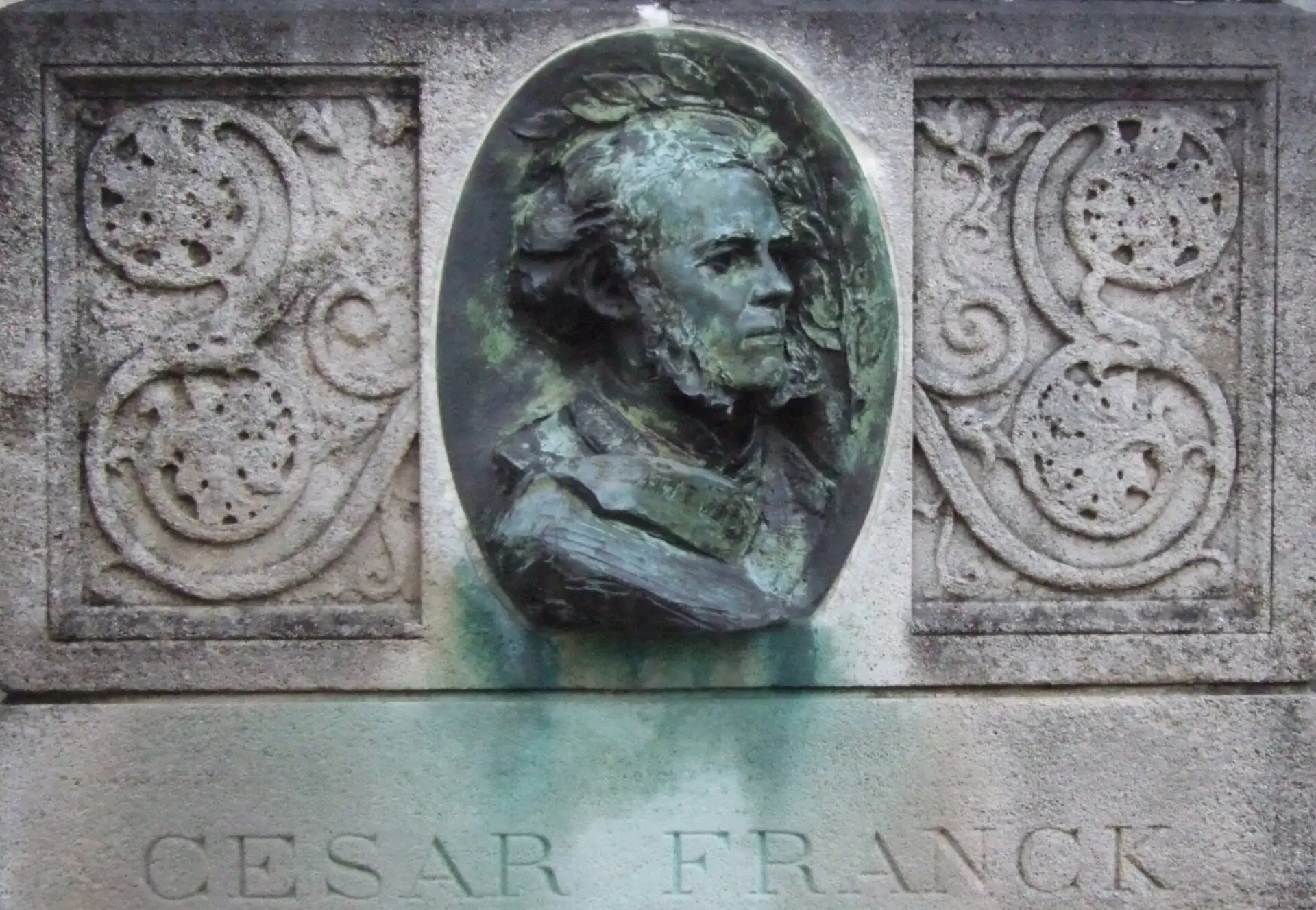
The Symbolists and Mystics
It is very tempting to focus solely upon Tournemire’s musical education through the Franckian and Widor schools of thought, but to do so would be to overlook the subject matter of his works and relegate Tournemire to that of a mere musician. Tournemire would intellectually move far beyond his maître César Franck through his endeavours with the Symbolists, and his music would take on a philosophical dimension rather than a simplistic musical one.
In 1903, Tournemire married a woman named Alice Taylor (1870–1920), whose sister, Christine (natus 1864), was the second wife of Joséphin Péladan (1858–1918). Péladan was a French mystic who was a leading figure of the French occult revival and the founder of an Order of the Rose ✠ Croix in Paris. In the 1890s, Péladan’s Rose ✠ Croix hosted six salons whose subject matter dealt with religion and mysticism. They involved over two hundred visual, literary, and performance artists and served as a promotional vehicle for the Symbolists. Of art, Péladan remarked:
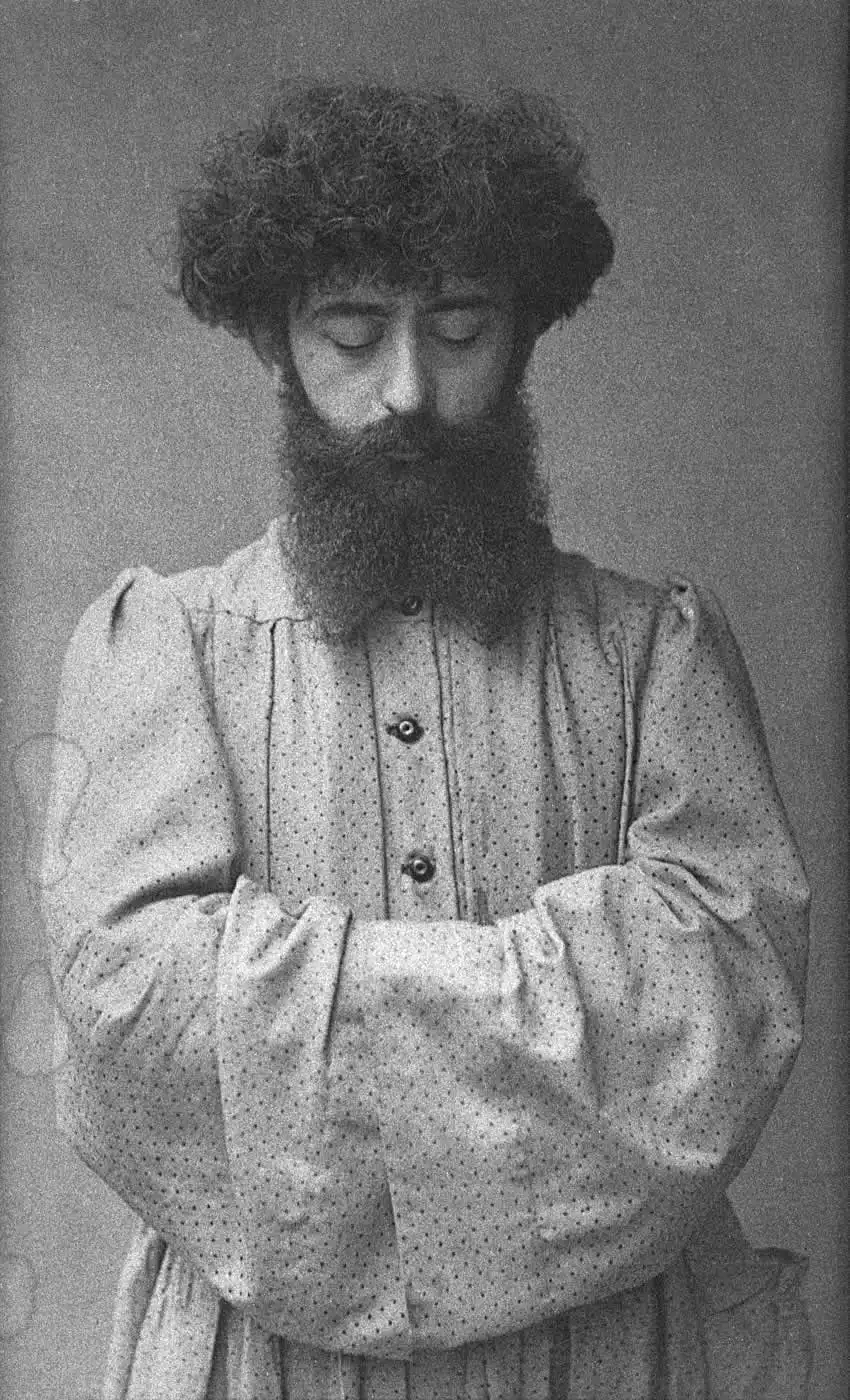
Joséphin Péladan
Art is man’s effort to realise the Ideal, to form and represent the supreme Idea, the Idea par excellence, the abstract Idea. […] Making the invisible visible: that is the true purpose of art and its only reason for existence. [122]
The Symbolist Movement first emerged in the literary genre through the poetry of Charles Baudelaire (1821–1867), Paul Verlaine (1844–1896), and Stéphane Mallarmé (1842–1898), as well as the plays of Maurice Polydore Maeterlinck (1862–1949). The movement then expanded into the visual arts and later the performing arts. The poet Jean Moréas (1856–1910) published what would become known as the Symbolist Manifesto in Le Figaro in 1886. In the article, Moréas wrote that one should “clothe the Ideal in sensible form.” He continued:
Thus, in this art […] none of the concrete phenomena are manifestations of themselves: these are rather the sense-perceptible appearances whose destiny is to represent their esoteric affinities with primordial Ideals. [122]
This artistic movement owed much to Arthur Schopenhauer (1788–1860) and his Neo-Platonic vision of the world, and was a reaction against Auguste Comte’s (1798–1857) Positivism, which was becoming a philosophical and political force in France at the end of the nineteenth century. It was also in direct contradistinction to Armand Gautier’s (1825–1894) notion of “art for art’s sake”, which, likewise, was garnering caché in the art world.
In the Symbolist world, art sought to exhibit correspondence with the noumenal through the semiotic use of figurative imagery to evoke a sense or ken of the ontological. In the Symbolist conception, art is theology and philosophy—not simply æsthetics or a sensual delight and amusement. In this system, art is a kind of language—a conceptual, communicative medium used in philosophical discourse—and a tool of epistemology.
Theirs was a qualitative versus a quantitative linguistic and conceptual system—a system that they felt to be more apposite to the perception and denomination of the ineffable nature of Truth than the more comforting realm of Materialist categorisation.
Informed by the Symbolist outlook, Tournemire also came to revere the literature of the nineteenth-century novelists, essayists, and Catholic mystics, Joris-Karl Huysmans (1848–1907), Ernest Hello (1828–1885), and Léon Bloy (1846–1917). Bloy, who was known by the moniker The Pilgrim of the Absolute, said of himself, “I am so much at home in the Absolute that the man who does not speak the language of the Absolute tells me nothing.” [126] Tournemire was of the same ilk.
Tournemire would also develop religiously in a manner that would seem foreign to Franck’s simple piety. Unlike most people who espouse a religious ideal, Tournemire’s faith was not a simple a priori assertion that can be rationalised as a mere desideratum, or a sentimental retreat from the world, or a philosophically atavistic return to the womb. Péladan instilled in Tournemire a sense of religious erudition that led him on a scholarly sojourn down an anfractuous intellectual path. Far from condemning world religions, Tournemire considered the faiths of the world to be a foreshadowing of Christian ideals or, indeed, a societal pilgrimage, with Christianity being an ultimate telos.
Just as in understanding other languages, one becomes more enlightened and facund in one’s own mother tongue, it is likewise true when it comes to other disciplines; and to that end, his studies of religions were quite ponderous. In his Mémoires, he discusses the religions of ancient Egypt and Assyro-Babylon along with the religious and philosophical contributions of the Romans and Greeks: Cicero, Æschylus, Euripides, Sophocles, Homer, Cato, Socrates, Plato, Aristotle, Virgil, Tacitus, Homer, Archilochus, Pindar, Phidias, Polykleitos, and Zeuxis. He delves into the Indo-European religious systems of Persia and pre-Christian Germanic and Scandinavian religions. He discusses the Sino-theisms of Confucianism and Taoism, as well as Shinto in Japan. He then turns his attention to Christianity, citing the ancient apologists Tertullian and Origen and saints like Saint Augustine (of whom he quotes extensively from his Confessions), Saint Ambrose, Saint Francis of Assisi, and Saint John of the Cross.
Through scholarly erudition rooted in philosophia perennis, Tournemire excogitated a religiously pansophical teleological dialectic that Peter Bannister (natus 1966) would term a Theosophical Eschatology. This Theosophical Eschatology, which developed through his mystical esotericism, represented a progressive theistic journey—a theology of history to a Christian notion of salvation. [133] In his Mémoires, he noted the historical path of theistic evolution:
All religions of the civilised world began with the worship of the forces and phenomena of nature, mainly solar and atmospheric phenomena, that is to say, by animist naturalism. By constant progress, they came to polytheism. And it is only after having passed these two steps that it would reach the heights approaching the monotheistic idea. [136]
It was through this expatiation of oriental and occidental metaphysical theorems and religious languages and the frameworks of these traditions that his musical œuvres would be set apart from the pedantic musicians of his time, colouring the harmonic, rhythmic, and melodic manifestations of his works while also imbuing them with a profound depth of meaning.
Tournemire was a Post-Enlightenment Neo-Medievalist modernist. There was a similar movement in philosophy in the early twentieth century in the form of Jacques Maritain’s (1882–1973) Neo-Thomism. They both were looking to a time before the delimiting bounds of Materialist categorisation that came of age during the Enlightenment.
Just as Maritain looked to Aquinas, Tournemire looked to music of that period—that is to say, Gregorian chant—because it was an emanation of a people that processed information in a “mystical” metaphysical way. In the sequence for Corpus Christi, Aquinas wrote, “Under diverse forms are hidden glorious things to sight forbidden, signs alone, not things, we see.” Chant was a music of this intellectual understanding. So when chant is called upon in Tournemire’s music, he is not employing it as a liturgical musical punctilio; he is drawing upon a deeper conceptual perspective.
In the wake of this educational background and the sobering realities of the Great War that devastated Europe, Tournemire’s Weltanschauung moved beyond Franck’s nineteenth-century Romantic perspective. Tournemire’s works began to embody an eschatological aura informed by an erudite, pansophical synthesis—a Franckian, Symbolist, theosophical mysticism.
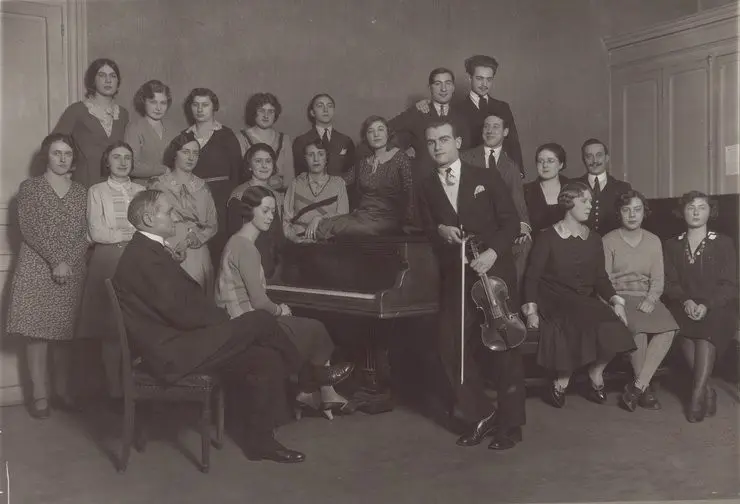
Charles Tournemire as Professor of Ensemble Class
The Threat to Franckianism
While he was able to attain Franck’s position as organist of Sainte-Clotilde, there was within Tournemire a sense of destiny regarding the vindication of the Franckian tradition through his vocational career path, which included acquiring Franck’s position as Professor of Organ at the Conservatoire.
Tournemire was appointed Professor of the Ensemble Class in 1919 upon the resignation of the violinist Lucien Capet (1873–1928), who wished to focus on his performance career. However, this was simply a means to an end. All signs indicated that he was the heir-apparent for the organ professorship when the job was to become available. In 1911, Tournemire (along with Vierne, Gigout, and Bonnet) was considered among the candidates to succeed Alexander Guilmant (1837–1911) (Widor’s successor). Further creating this impression, the organist Eugène Gigout (1844–1925), who successfully assumed the mantle of organ professorship, emphasised improvisation and chant accompaniment, so Tournemire was not only seen as the natural heritor to the post due to his musical pedigree, but he was also seen as the logical successor to carry the baton into the future due to his pedagogical emphasis.
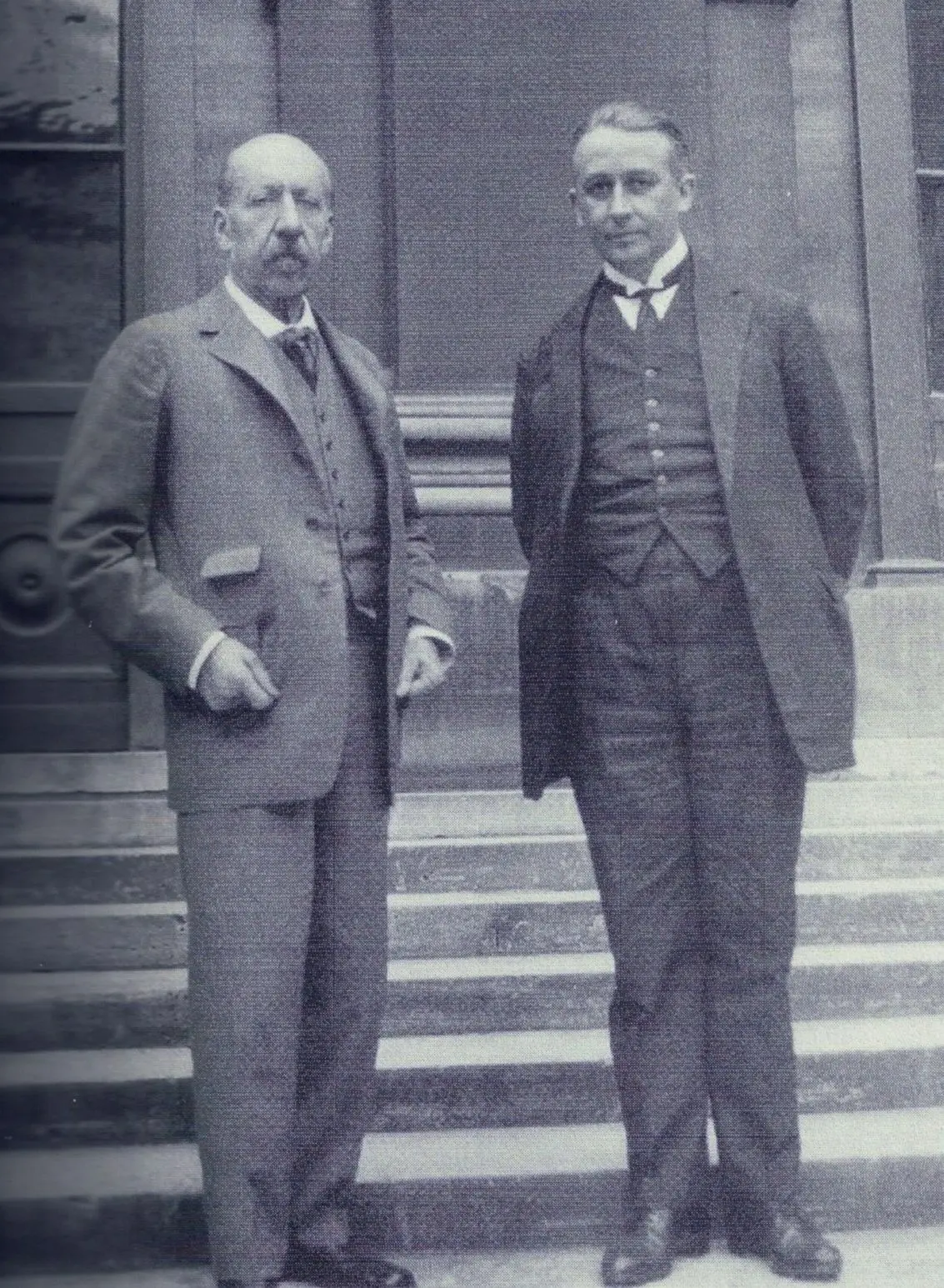
Charles-Marie Widor and Marcel Dupré
The opportunity came in 1925 with the death of Gigout; however, the enmity established at the Conservatoire between Tournemire and Widor could not obviate the inevitable. With the prodding of Tournemire’s nemesis, Widor, in 1926, Tournemire was glossed over for Widor’s protégé, the forty-year-old Marcel Dupré.
This organ virtuoso had developed a well-cultivated, performance-oriented career that resulted in a prodigious cult-following and societal éclat. In the end, Widor, along with—according to Tournemire’s estimations—Marcel Dupré’s industrious and politically cunning wife, Jeanne Dupré née Pascouau (1883–1978), stole Tournemire’s apparent birthright. In his Mémoires, Tournemire wrote:
Here can be placed [in these Mémoires] a very important event in my artistic career: my appointment as Professor of Music at the Paris Conservatoire (November 1919). I accepted this position without solicitation, with the almost certainty of obtaining, thereafter, the Organ Chair of the same Conservatoire.
Alas! I failed… I had against me his excellency Widor, Rabaud himself, and the Levantine Paul Léon. After my failure, one could read in the Cri de Paris this kind of snippet as follows [dated the seventh of March 1926]:
“Monsieur Marcel Dupré has been appointed Professor of Organ at the Conservatoire. The Minister has confirmed the appointment of the candidate, who had been made, according to the rule, by the Board of Education. Insinuating and vigorous pressure was exerted on the Minister to get him appointed to the Organ Chair, although the candidate was as yet the second in line….”
From all the evidence, Monsieur Marcel Dupré was the instigator of this disgraceful act as well as Madame Dupré. Tournemire has never known intrigue. In this sad affair, it is only necessary to retain one thing: the lack of decency of my “rival” vis-à-vis with respect to an artist of my age, at the very least! So too, the lack of candour of Rabeau, who had long promised me this post…. [169–170]
Widor had again threatened the perpetuation of the Franckian Tradition—an act that struck in the heart of Tournemire both horror and grief.
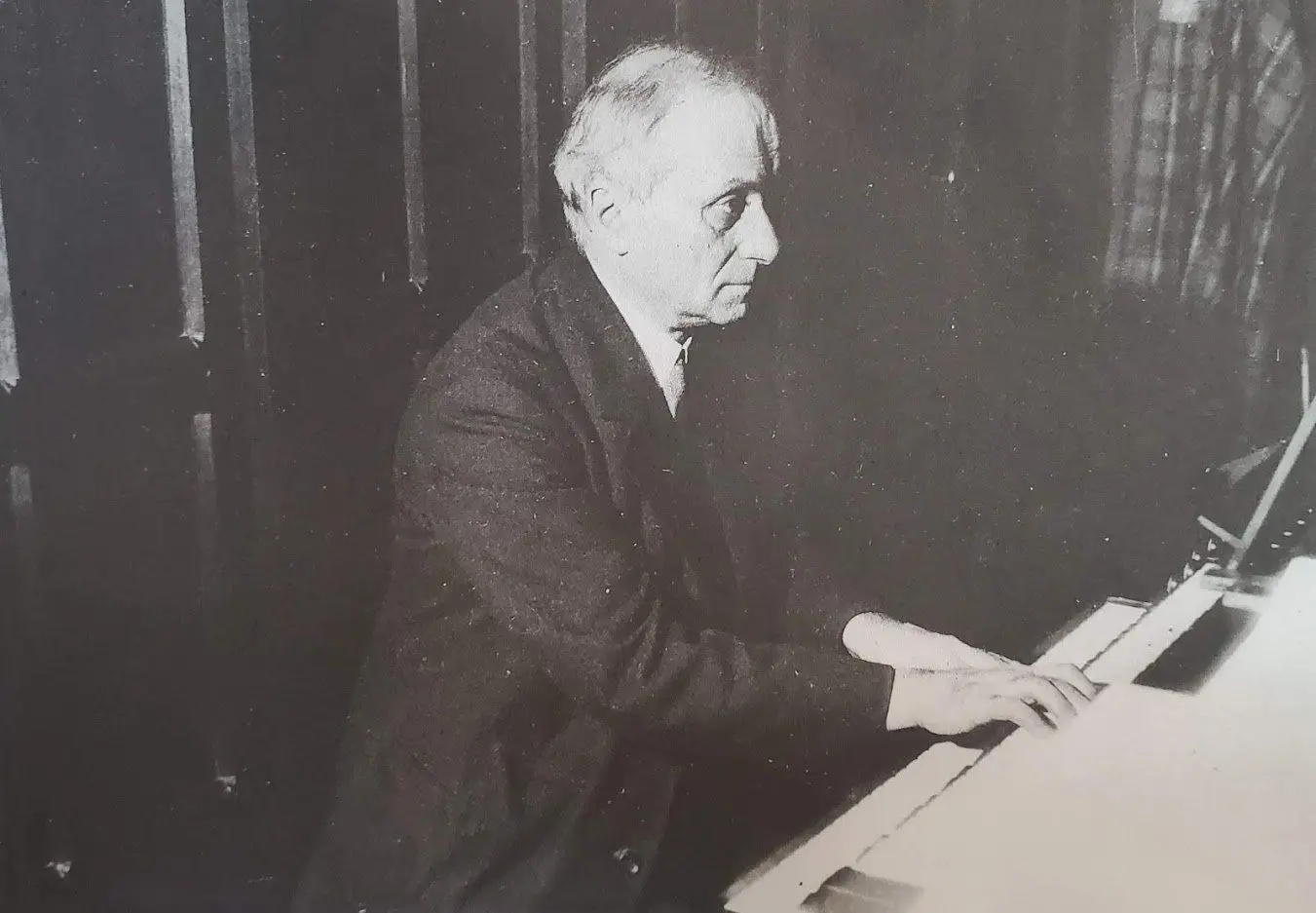
Charles Tournemire at Sainte-Clotilde
Vindication through a Franckian and Symbolist Synthesis
L’Orgue Mystique (1927–1932) would mark the moment when Tournemire would merge his Franckianism and Symbolist outlooks and define what he thought it meant to be a Franckian in a renewed way. Prior to L’Orgue Mystique, Tournemire had a prolific career as a composer, having composed eight symphonies, several operas, many chamber works, and a smattering of organ works.
However, having failed to attain the organ professorship, Tournemire sought to vindicate the Franckian Tradition and set out to compose L’Orgue Mystique, which became a manifesto on the Franckian Ideal. After years of cajoling, Joseph Bonnet (1884–1944) was able to convince Tournemire to take on the task of writing a “liturgical year” based upon Gregorian chant. However, this endeavour took on a new meaning with the appointment of Dupré, and so on the fourth of January 1927, at Bonnet’s marriage to Geneviève Turenne (1899–1972) at the church of Saint-Ferdinand-des-Ternes, he expressed his intent to take on this monumental composition.
L’Orgue Mystique would be accompanied by Tournemire’s book, César Franck, which ostensively was a biography but was, in fact, a Franckian-Symbolist Synthesis that sought to define Tournemire’s musical philosophy. Written at the end of 1930, it was published in 1931 as the fifth volume of Les Grands musiciens, par les maîtres d’aujourd’hui by Librairie Delagrave of Paris. He begins the book on an apocalyptic note:
Now is the time, in this age when the grinding of machines inflames the minds of some and dries up the hearts of many, to glorify Beauty. For is it truly necessary to lose all hope, to fear that expressions of the sublime will no longer sound forth on earth?
To do so would defy the supreme law that requires from the man of good faith a tribute of admiration owed to the One who is.
Did we not witness, just yesterday as it were, the infinitely gentle spirit which hovered over the souls of the generation of artists now dying out?
I have in mind the mystical currents in the art of César Franck which have been increasingly misunderstood during the last twenty years, a situation I consider both disappointing and dangerous….
Such a sickening state of affairs seems to come from the lowest depths in order to obscure the grandeur of art!
Ernest Hello wrote:
“Art has completely lost its head. After seeking its models in shadowy regions, after forgetting that the sun is its domain, after attempting the apotheosis of evil…, after trying to separate Truth from Beauty, it turned against Beauty. Having given itself a mortal blow, art wished to end it all. Having persuaded men that disorder, in other words, the false, constituted Beauty, it cried out, according to its own mad logic: the Beautiful is the ugly!… Greek art was unaware of this folly. Its beauty is to be found entirely in a state of repose…. Art, in order to find this serenity, must rediscover both lofty peaks and profoundest depths. Foam is always moving to and fro, agitated, carried away, impetuous; but the foam is not the ocean.”
The foam is not the ocean!
Why is man, who has within him the seed of a spiritual, moral existence, impelled, as if by a kind of bad instinct, toward what is vain, futile, purely superficial? That might be understandable, at most among heathens; but after nineteen hundred and thirty years of Christianity, one remains astonished, on the morrow of the most devastating of wars, by the insensitivity, by the selfishness and pride of those whose mission is to spread on earth that manna from heaven, necessary to the life of the soul, by creating a work of art. [133]
Immediately, one hears, through his use of religious language and the employment of the writing of the contemporary Catholic mystics with whom Franck would have only passing knowledge and interest, that this monograph on César Franck is an eisegetic window into Tournemire’s soul and is not simply about his maître. Even the allusion to the ocean hearkens to Tournemire’s love of the sea and his summer home on the Île d’Ouessant where he composed much of his music.
Tournemire’s César Franck must be read when studying L’Orgue Mystique because Tournemire saw this work as a modern reification of the Franckian Ideal. The content and the scope of this project sought to vindicate the injustice rendered upon the Franckian legacy through the appointment of Dupré. Tournemire’s biography, therefore, became a thinly veiled manifesto on the creation of L’Orgue Mystique and the greater calling of a church musician, and César Franck became a mythic avatar of that ideal. In it, Tournemire extols the chorale formula, citing Franck’s Trois Chorals:
The highest expression in organ music is known through the chorale. The pure style which derives from it sets it apart. It is not just a question of the writing; the scope is higher: It is the result of a special spiritual state…. From the moment the composer enters this temple fragrant with incense, he feels filled with dignity: his soul, in an attitude of prayer, is suffused with brilliance. [273]
Tournemire would employ twenty “chorales” in L’Orgue Mystique alone, notwithstanding his other chorales: the Triple choral (1910), the Sept Chorals-Poëmes d’Orgue pour les sept paroles du Xrist (1935), and the Symphonie-Choral d’Orgue (1935). However, Tournemire frames the chorale referencing nomenclature that cites various movements of L’Orgue Mystique (e.g., Verrière, the Fresque of Sexagesima, the Fresque alléluiatique, the Prélude et fresque, and the five Chorals alléluiatiques), and he reframes the “chorale” in terms of Gregorian chant, which was not a thematic priority in Franck’s music. He then concludes with a citation from the Venite, exultemus Domino, which—in addition to its oceanic imagery with which Tournemire had a strong affinity—forms one of the Leitmotif Gregorian chants cited throughout L’Orgue Mystique:
What is most remarkable in Buxtehude’s works is his intentional emancipation from the Protestant chorale: two of his most important works prove this: Magnificat, Te Deum. In these monuments, the plainsong naturally has the place of honour (less the rhythm, since each note is converted into a whole note). What contrapuntal sumptuousness: flamboyant “rose window” [verrière], alleluia-like “frieze” [fresque alléluiatique].
One can see here, without any doubt, the origin of the vast conception of the Angelic Master: the “Latin” chorale [plainsong] more subtle than the Lutheran hymn tune.
Before leaving the Old Masters, it is fitting to pay loving, respectful homage to the Cantor from Leipzig.
The conceptual liberty, the imagination, applied to the ornamental melody, much criticised—under the pretext that the melody line effaced—makes of this astonishing art, unequalled in conceptual power, the one model always present in my mind.
The chorale seemed to have said everything. It is thus that after a deep sleep of about one hundred and forty years, a bold undertaking left its imprint upon a most significant period in the history of music: there was a blending of two supremely important forms: choral variation and Beethovian Fantaisie (the last quartets).
A brilliant union, expanding certain aspects of the chorale.
A glorious new creation had been born. It still ennobles César Franck.
It is bittersweet for me to analyse the Trois Chorals, for I cannot forget the emotions I felt the day when the maître let me hear these magnificent works on the piano in his home. [273]
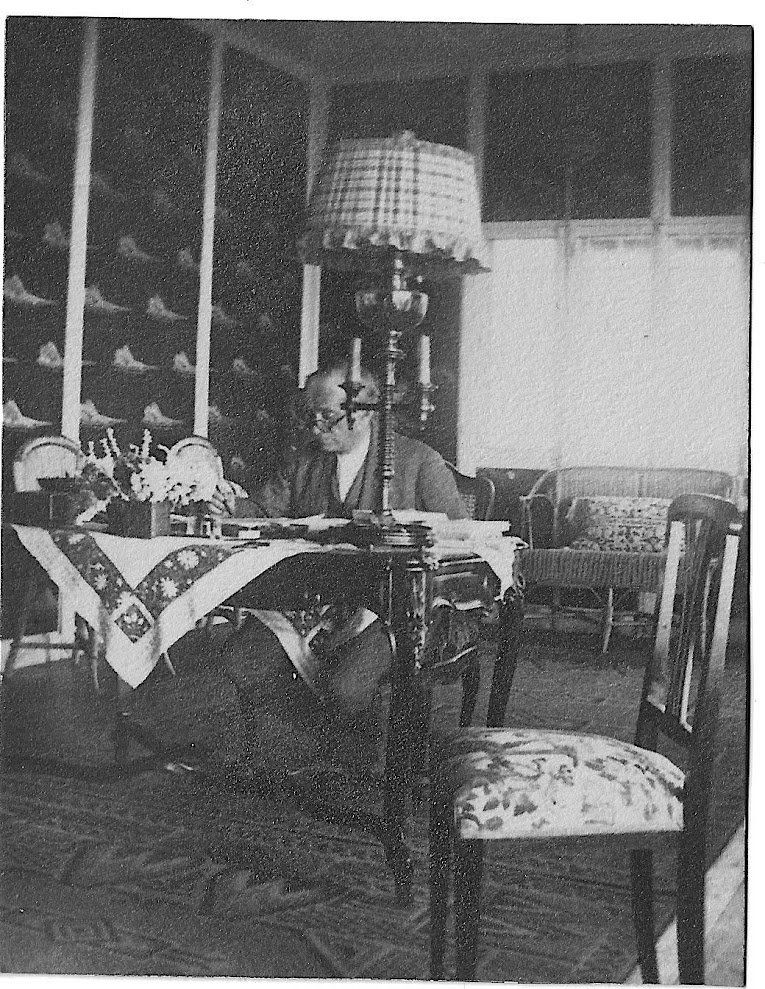
Charles Tournemire
Indeed, at the end of the monograph, Tournemire is quite overt about his motivations:
For more than two hundred years, the richness of these different [Gregorian] modes, each one having very distinct traits, has really not been exploited. Buxtehude, Bach’s master, is the last great musician using them scientifically as well as artistically. If one dreams about the extraordinary mixture of “scales” found in a rather large number of Gregorian-inspired pieces (sometimes three modes), one can have an idea, a priori, of the liberty and of the special nature which characterises a work built upon foundations of this kind. Adding to this valuable artifice, the incomparable suppleness of plainsong’s waves of sound, miraculously intertwining, containing in themselves the basis of an intense musical existence, being able to give birth to all forms of composition—chorales, paraphrases, fantasias, sacred symphonies, oratorios, sacred dramas—it is easy to grasp the immense extent of the field of investigation which is presented to us.
Limitless possibilities able to create an unexpected art—always of lofty sentiment, attaining complete lyricism, a synthesis with a higher existence; infallible means to hold fast within the sublime realm of pure thought and to give, thus, full satisfaction to the religious and philosophical ideal of the Great Cantor: “All music which has goals other than the glorification of God and the rejoicing of the soul is only talk and devilish chatter.” Abundant nourishment, always renewed, constantly breathing life into the supernal movements necessary to the flights of the soul—sacred art, you are all that.
At the hour when the thirst for changing the language and the forms becomes imperative, when anxiety takes hold of the spirit, when one would break—not without brutality—the glass palace in which one fears imprisonment, how can one not rejoice at the priceless freedom to construct something which is made of complex rhythmic schemes, enchanting modalities, genuine and ingenious polytonality? Synthesis of several centuries of musical art brought together. When art is concerned, the conception of the generative lofty idea is absolute. The particular “flavour” of a Schubert cannot be diluted; and, something quite mysterious, a truly original and emotive harmonic progression cannot grow old!
It bears, nevertheless, the mark of its time. However, like a handsome face unmarked by time, it contains in itself an indefinable charm. This does not mean that it is not necessary to greet joyfully the contribution by new generations that is based upon the past. Is it not thus that everything which comes from man’s imagination and sensitivity is enriched?
César Franck recommended that we should not imitate him but seek our own solutions. In this spirit, may I say that attempts to achieve, especially in some area dear to our maître, would probably have satisfied the requirements of his essentially liberal teaching: possibilities of being oneself within the limits where one is able to aspire to it. In short, why should I hide my emotion while thinking that the Dispenser of Grace, indeed, wished to grant me that power to praise Him with simple musical prayers: L’Orgue Mystique? And why not add that I found therein the path which leads to the prayerful contemplation of unfathomable depths!
Let us contemplate the ocean! Does not its voice—great, deep, and sometimes terrifying—announce to us the majesty of the One who gives it life? Does one not see therein the image of life: the unleashing of the waves, the quelling, the infinite calm? Does it not sing—and with what loftiness—ceaseless and ever-changing hymns? When the wave breaks, how magnificent, and when it reaches the summit of a high rock, bursting forth its spray, let us give wonder and sing:
“O come, let us sing unto the Lord: let us make a joyful noise to the rock of our salvation. Let us come before his presence with thanksgiving, and make a joyful noise unto him with psalms. For the Lord is a great God, and a great King above all gods. In his hand are the deep places of the earth: the strength of the hills is his also. The sea is his, and he made it: and his hands formed the dry land.” (Psalm xciv/xcv) [234–235]
A contemporary review of Tournemire’s book in The Musical Times, while acknowledging his flamboyant language, conceded that the book was less a biography about Franck than it was about the Franckianism of the generation following:
Although it has been given to many today to hear and love the works of music’s Pater Seraphicus, a real knowledge of it is a rare thing. To understand him wholly and, even more, to interpret him, one has to be adept. There is, therefore, something very apt in the choice of Tournemire—pupil, disciple, friend, and successor at Sainte-Clotilde—to write the little book on Franck in Delagrave’s series of Les Grands musiciens, par les maîtres d’aujourd’hui. Monsieur Tournemire has not only the minute knowledge of his subject that he needed to have but the deep experience of the Franckian atmosphere that we need he should have. He can convey to us perfectly the arcana of Franckism. If, sometimes, his style (always concise to the point of being doubtful) becomes apocalyptic—well, he is only approaching the nearer to his subject. For anyone (and particularly for any organist) who wishes to ripen his own understanding of Franck’s works, this study would be very profitable….
Monsieur Tournemire writes on improvisation from long experience, and, as a master himself in that typically French art, his remarks are doubly valuable to us. “Harmony, counterpoint, fugue, composition and orchestration are indispensable. Fifteen years’ study at least. Reading and analysis of masterpieces of all periods; penetration of all the forms that proceed from them: six to seven years of absorption of music! In addition, for the better assimilation of capital works, copying parts of them…. And that is not all! Experience of life, fortified every day by meditation of things other than music, is a sine qua non…. We will even go so far as to say that one cannot improvise maturely until one has reached the third period of human life.” Golden words for us, who imagine that we learn to become complete musicians in the course of three years’ standardised college training! Music is, after all, the art that most depends upon personal contact and individual experience; and perhaps, of all the masters, Franck is the one who can least be taught in the schools and from whom one learns most, in the end, by one’s own application. One must explore the work alone and lengthily; and as cartographer and interpreter, none could be better than Monsieur Tournemire. [65–66]
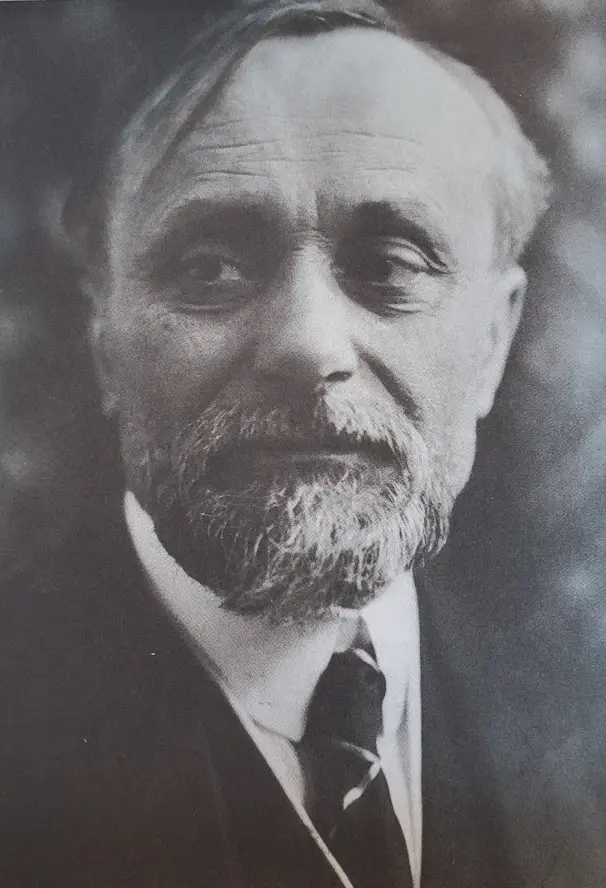
Charles Tournemire
Conclusion
César Franck was, indeed, a musical luminary, but the mythic status that was subsequently bestowed upon him was informed by the life experiences of La Bande à Franck. Tournemire was foremost among the remythologisers. As Socrates was to Plato, Tournemire would see his maître as a legendary figure through which his own thoughts would be channelled. Having lost his teacher at a young age and having such a limited experience with Franck, Tournemire, in his mind, could conjure a personified ideal that he could strive to emulate.
Franck certainly created a musical foundation for Tournemire to build upon. However, through his experience with Péladan and the Symbolists, Tournemire’s education developed beyond what Franck would have recognised, and after the First World War, the Europe that Franck had known had been irrevocably transformed. The nineteenth century had ceded to the twentieth century—the dynamism and optimistic perception of inevitable societal progress that characterised Romanticism had fallen to the sober realities of Modernism.
Yet, understanding the ways succeeding generations frame their thoughts is not a fruitless endeavour. The act of historiographic emplotment can be seen as a quasi or latent autobiographical exercise on the part of the author. Indeed, it is a challenge—if not an impossibility—to avoid subjective historical eisegesis when looking back to a bygone age. Historical eisegesis is a form of truth-telling—one that is about a present, living reality—a perennial truth, whereby the seeds sewn by a previous generation continue to flower and bear fruit for a future age.
Tournemire’s hagiographic awe of his maître César Franck is a window into a world of thought—a sacred and mystical world that mythologised a kind and noble individual in order to hominify an Ideal. It was through his historical eisegesis that Tournemire created a persona to emulate and an Ideal to entify throughout his life.
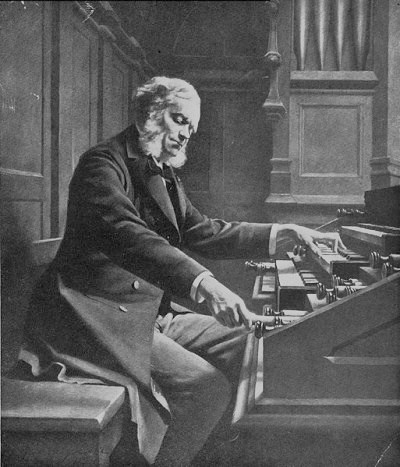
A version of this essay will be appearing in Organists’ Review Magazine in 2027. Bracketed page citations are from Charles Tournemire’s L’Orgue Mystique: La Haute Mission, published by The Leupold Foundation.
Support the Tournemire Film Documentary
Learn how you can support the film documentary on Charles Tournemire produced by the award-winning Fugue State Films. This landmark project will feature scholars and performers from around the world as they delve into the fascinating life and times of Charles Tournemire and his musical masterpieces.
Bibliography
A. F. “César Franck by Charles Tournemire.” The Musical Times, volume lxxij, number 1,063 (1 September 1931): 800–801.
Bannister, Peter. “Charles Tournemire and the ‘Bureau of Eschatology’.” Mystic Modern: The Music, Thought, and Legacy of Charles Tournemire. Edited by Jennifer Donelson and Stephen Schloesser. Richmond: Church Music Association of America, 2014.
Chaitow, Sasha. Symbolist Art and the French Occult Revival: The Esoteric-Aesthetic Vision of Sâr Péladan. Paper presented at the Third ESSWE Conference, Lux in Tenebris: The Visual and the Symbolic in Western Esotericism, 2011.
D’Indy, Vincent. César Franck. Translated by Rosa Newmarch. London: The Bodley Head John Lane, 1910.
Davies, Laurence. César Franck and His Circle. Boston: Houghton Mifflin Company, 1970.
Ianco, Pascal. Charles Tournemire, ou Le Mythe de Tristan. Genève: Papillon, 2001.
Kneeream, Ralph James, Jr. A Translation/Edition of Charles Tournemire’s “César Franck.” A dissertation submitted in partial fulfilment of the requirements for the degree of Doctor of Music, Northwestern University, October 1983.
Kunel, Maurice. César Franck: L’homme et son œuvre. Paris: Bernard Grasset, 1947.
Leblanc, Jean-Marc. “Mémoires de Charles Tournemire Édition critique.” L’Orgue: Bulletin des Amis de l’Orgue, volume 2018: i–iv, number 321–324 (October 2019).
Lord, Robert Sutherland. “The Sainte-Clotilde Tradition.” The American Organist (February 1982): 38–40.
Near, John R. Widor, A Life beyond the Toccata. Rochester: University of Rochester, 2011.
Pfleger, Karl. Wrestlers with Christ. Translated by E. I. Watkin. Freeport, New York: Books for Libraries Press, 1936.
Schloesser, Stephen. Jazz Age Catholicism: Mystic Modernism in Postwar Paris, 1919–1933. Toronto: University of Toronto Press, 2005.
Smith, Rollin. Louis Vierne: Organist of Notre-Dame Cathedral. Hillsdale, New York: Pendragon Press, 1998.
Spotts, Richard Christopher. Charles Tournemire’s L’Orgue Mystique: La Haute Mission. Colfax, North Carolina: The Leupold Foundation, 2024.
Stove, Robert James. César Franck: His Life and Times. Plymouth, England: Scarecrow Press, 2012.
Tournemire, Charles. César Franck (Les Grands musiciens par les maîtres d’aujourd’hui). Paris: Librairie Delagrave, 1931.
Tournemire, Charles. Mémoires (1886–1939). Manuscript, 1939.
Van Wye, Benjamin. The Influence of the Plainsong Restoration on the Growth and Development of the Modern French Liturgical Organ School. Doctor of Musical Arts dissertation, University of Illinois, 1970.
Vierne, Louis. “Memoirs of Louis Vierne; His Life and Contacts with Famous Men.” The Diapason (October 1938): 10–13.
Vierne, Louis. Mes souvenirs. An annotated translation by Jack Reed Crawford. A thesis presented in candidacy for the Degree of Doctor of Philosophy, University of Miami, 1973.
Weidner, Raymond. The Improvisational Techniques of Charles Tournemire as Extracted from his Five Reconstructed Organ Improvisations. A dissertation submitted in partial fulfilment of the requirements for the degree of Doctor of Philosophy, Michigan State University, 1984.