SUPPORT THE NEW TOURNEMIRE DOCUMENTARY
Produced by Fugue State Films.
Learn More Here
L’Orgue Mystique: A Liturgical Symphony

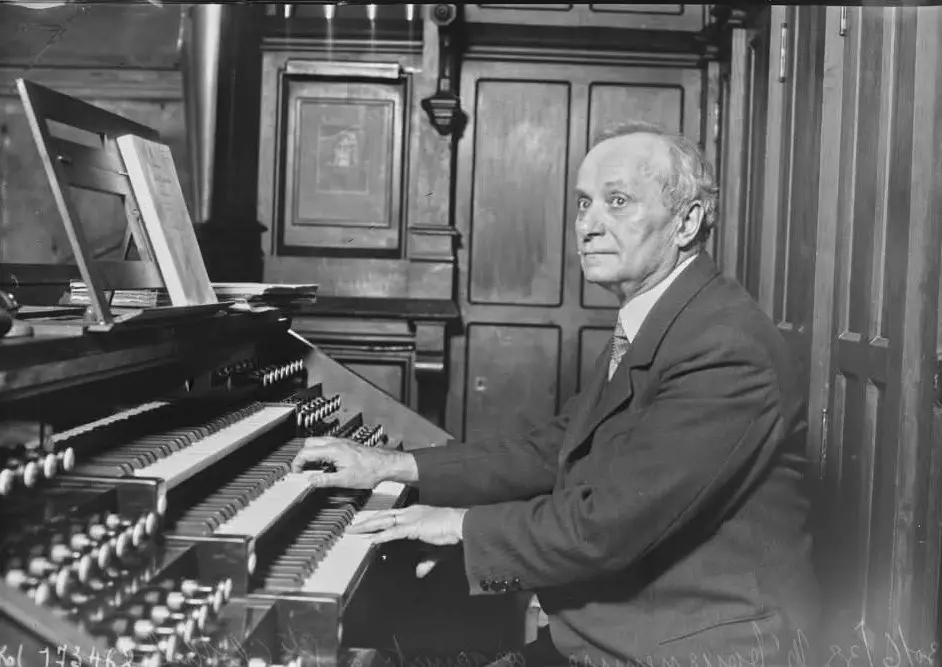
This article was published in the January 2026 issue of The Diapason in anticipation of the Complete Performance of Charles Tournemire’s L’Orgue Mystique at Saint Paul’s Episcopal Church in Chestnut Hill.
A Solemn Declaration to Embrace a Calling
On the fourth of January 1927, the organist Charles Tournemire (1870–1939) played for the marriage of his student Joseph Bonnet (1884–1944) to Geneviève Turenne (1899–1972) at the church of Saint-Ferdinand-des-Ternes; and at that wedding, Tournemire announced—in the presence of Louis Vierne (1870–1937), his fellow Franckian classmate, and Dom Joseph Gajard (1885–1972), choirmaster of Solesmes Abbey—that he would begin work on what was then termed L’Orgue Glorieux. Bonnet had long been advocating for just such an endeavour, but it was only after considerable cajoling on the part of Bonnet that Tournemire would embrace this call and take on the task; so with this solemn declaration, Tournemire began his epic masterpiece, L’Orgue Mystique.
L’Orgue Mystique—Tournemire’s two-hundred-fifty-three-movement, fifteen-hour-long masterpiece—is a work of Wagnerian scale. Comprised of fifty-one Offices commemorating Sundays and principal Feasts of the Church Calendar, these five-movement cycles were designed to be incorporated into the French Catholic Grand Messe, performed in dialogue with the prescribed Gregorian chants sung by the choir. Yet, despite its liturgical foundation, Tournemire conceived the work not only as a set of liturgically prescribed moments, but he also viewed the work as a unified religious symphony to be comprehended and experienced as a complete entity.
Choral alléluiatique nº V by Charles Tournemire
The Birth of a Masterpiece
Joseph Bonnet’s role in instigating Tournemire to take on such a task and setting L’Orgue Mystique’s “agenda” cannot be underestimated. In 1922 (the year of Solesmes’s return to France after its exile to the Isle of Wight due to the 1905 Act of Separation), Cardinal Dubois (1856–1929) convened a Congress of Church Music that included the leading authorities in sacred music, in particular Gregorian chant. In his speech, Le rôle de l’organiste liturgique du grand orgue, Bonnet advanced his views on the centrality of Gregorian chant in the liturgy and the role of the organist in cultivating that tradition. He called for the creation of new musical works based upon chant. Classifying organ repertoire into two genres—the liturgical and the decorative—he sounded the call for a Catholic Liturgical Year, akin to Bach’s Orgelbüchlein:
If I dare, gentlemen, I shall express this wish on the subject of instrumental pieces, videlicet, that some sincere and talented artist, making use of the repertoire of Gregorian melodies, would compose a Liturgical Year for the organ in the same spirit as that which Dom Guéranger [(1805–1875)] wrote for the text. Indeed, the use of Gregorian themes in organ music by an organist-composer, well endowed with the gift for music and nourished with the liturgy, would be a guarantee of beauty and would assure a musical and liturgical unity…. What we need is a complete Liturgical Year for the organ. [108]
Indeed, Bonnet was calling for L’Orgue Mystique. Dated the fifteenth of June 1921, Bonnet gifted Tournemire Dom Prosper Guéranger’s fifteen-tome liturgical treatise, L’Année liturgique, inscribing, “À mon cher maître et ami Ch. Tournemire—En hommage d’admiration et d’affection profonde. Jos. Bonnet”, thereby sowing the seed. [240] The germinal period took several years, however. Nonetheless, by 1927—using L’Année liturgique, the 1922 edition of the Paroissien romain, and the 1926 edition of the Liber Antiphonarius—Tournemire conceived a one-hundred-and-sixty-one-page schematic for a work he was calling L’Orgue Glorieux, wherein he compiled chants with their translations along with corresponding devotional writings from L’Année liturgique.

Joseph Bonnet
In amongst the early developmental papers for L’Orgue Mystique, can be found a critical document: “Mardi de la Trinité—Premier office improvisé à Solesmes” and the words “Saint-Basile”, plus four themes for improvisation. [242] The feast of Saint Basil fell on Tuesday, the fourteenth of June 1927, and it is assumed that it was on this date that Tournemire tested the structure of L’Orgue Mystique at Solesmes and, from there, set out to compose the work. On the twenty-eighth of May 1927 (shortly before this visit), Tournemire wrote to Bonnet, thanking him for his support and expressing his intentions:
My dear Friend,
Your note gives me great joy. I will write to R. P. Testu [sic erat scriptum, Dom Charles Letestu (1902–1982), organist of Solesmes Abbey] to notify him of my arrival on the thirteenth of June [at Solesmes].
You understand that this will be my withdrawal of heart, of soul—for this period of my life will undoubtedly be my last.
God willed that it should be you, friend with distant roots, to be the happy spiritual guide.
I think only of my great work.
However, today I finished the long and mysterious preparation of all the liturgical Offices. [242]
From the onset, Tournemire saw L’Orgue Mystique as a cohesive whole, having both a liturgical function and a magnum opus that was to be seen as a sonorous monolithic work of sacred art.
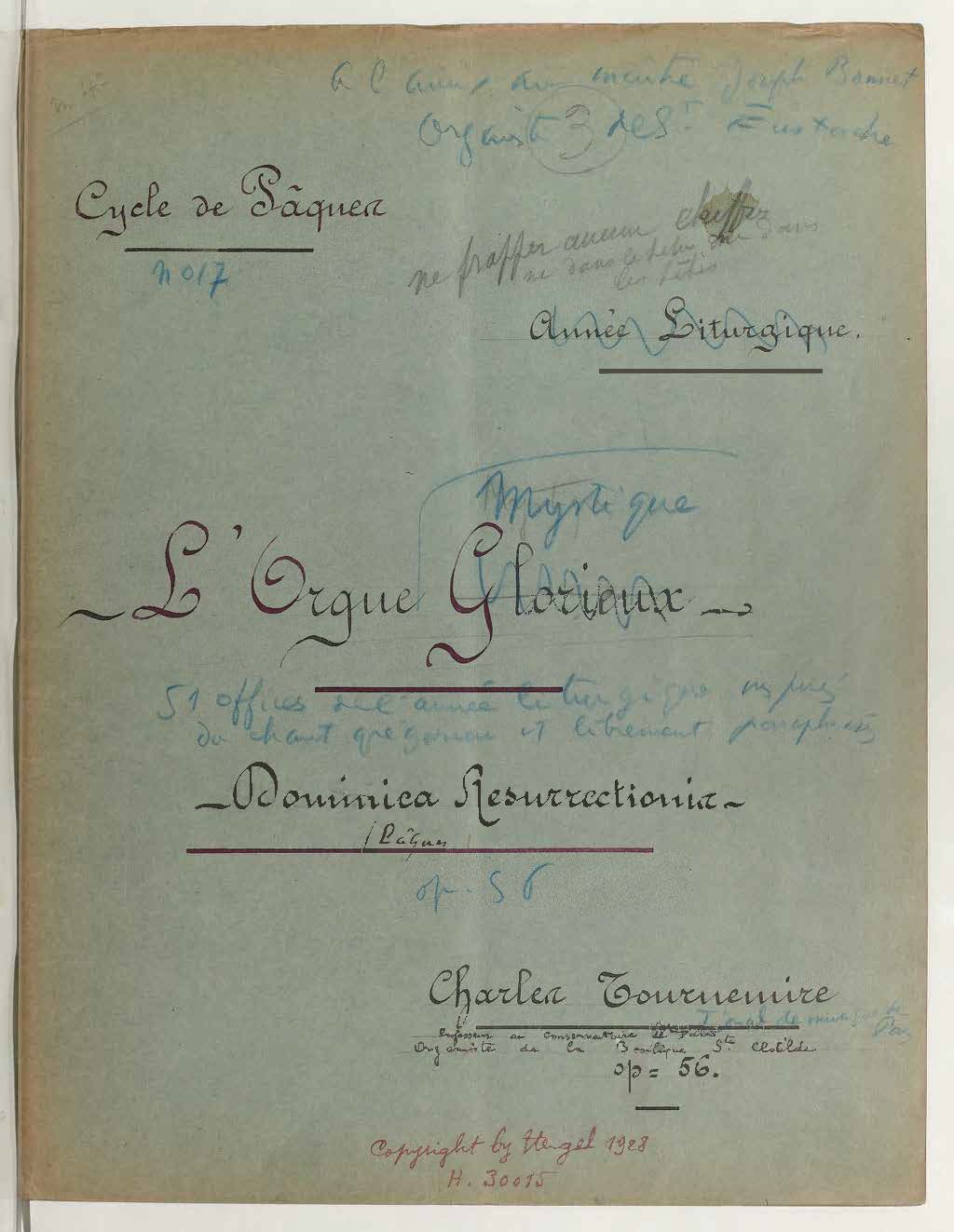
Front cover of the Office for Easter (the first Office to be composed)
with its dedication to Bonnet and the original title and subtitle to L’Orgue Mystique:
“L’Orgue Glorieux: L’Année liturgique”.
A Liturgical Symphony
It is crucial to perceive L’Orgue Mystique as a unified entity—a religious Wagnerian Ring Cycle, with the narrative being the liturgy itself. Both Tournemire and his wife insisted that L’Orgue Mystique ought to be performed in extenso, not only in part. Although it was designed to be performed in liturgical contexts, when consigned to liturgical settings, each Office of L’Orgue Mystique can be perceived as having complete autonomy, disassociated from the work as a whole. As it is folly to define faith through citing isolated scriptural passages apiece rather than integrating those pericopæ into the context of broader scholarship, so too it is folly to dissever the movements of L’Orgue Mystique and define them without seeing their context within the overarching compendium.
Tournemire imposed both a liturgical and a supra-liturgical structure upon L’Orgue Mystique, thereby imbuing the work with unitive “symphonic” attributes. On a surface level, each Office’s quinary formula (Prélude à l’introït, Offertoire, Élévation, Communion, and Pièce terminale)—with their standardised durations and liturgical functions and, therefore, Affeckt—create a natural sense of unity in the work. That said, the movements tend to fade away and blend or synthesise into each other, with each Office becoming a contiguous single work. Even many of the Pièces terminales end with a meditative yet anticipatory aura that suggests a musical “ellipsis” whose liminal qualities invite the listener to immediately engage in the next Office.
From the first note on the page, Tournemire establishes his supra-liturgical agenda by tweaking the order of Offices, beginning the work with Gaudete Sunday (the Third Sunday in Advent) rather than the Immaculate Conception (December eighth), which, chronologically within the context of the Liturgical Year, is a calendrical impossibility. In so doing, Tournemire enounces the Christological foundation of the work and that it was to be seen as an autonomous symphonic œuvre with liturgical originations while also possessing its own latreutic theological thesis.
He divides the work into three opuses based upon the Liturgical Year, which—through their narratives and musical structures—create three overarching suites: the Cycle de Noël (opus 55), the Cycle de Pâques (opus 56), and the Cycle après la Pentecôte (opus 57).
The Cycle de Noël and the Cycle de Pâques are purely guided by their respective Gospel narratives; however, with Cycle après la Pentecôte, Tournemire again manipulates the Liturgical Calendar to his own ends. Although usually experienced by congregations as a lengthy and meandering liturgical period, Tournemire organised the season after Pentecost into an overarching schema based upon the Pièces terminales of the Offices, creating a grand liturgical sonata-allegro.
He bookended the season with a trio of Offices: Trinity Sunday, Corpus Christi, and the feast of the Sacred Heart at the beginning and All Saints Day and the two subsequent Sundays at the end. Then, he divided the Pièces terminales into three five-week suites based upon the Gradual or Alleluia for the day: the Alléluia suite, the Choral suite, and the Choral alléluiatique suite. These groupings are divided by a Sunday employing a prelude-and-fugue followed by a Marian Feast Day. L’Orgue Mystique then concludes with an Amen coda or finalé incorporating the Te Deum. This extra-liturgical unifying framework is imposed upon the season by Tournemire to create structural cohesion.
Opening Trio:
In Festo Sanctæ Trinitatis: Triptyque
In Festo Corporis Christi: Fantaisie paraphrase
Sacratissimi Cordis Jesu: Prélude et fresque
Alléluia Suite:
Dominica IV–VIII post Pentecosten: Alléluia nº I–V
Fugue and Marian Feast:
Dominica IX post Pentecosten: Supplications et fugue modale
In Assumptione Beatæ Mariæ Virginis: Paraphrase-carillon
Choral Suite:
Dominica X–XIV post Pentecosten: Choral nº I–V
Fugue and Marian Feast:
Dominica XV post Pentecosten: Prélude et fugue
Nativitas Beatæ Mariæ Virginis: Prélude et louanges
Choral Alléluiatique Suite:
Dominica XVI–XX post Pentecosten: Choral alléluiatique nº I–V
Concluding Trio:
In Festo Omnium Sanctorum: Choral
Dominica XXI post Pentecosten: Fugue
Dominica XXII post Pentecosten: Postlude alléluiatique
Coda or Finalé:
Dominica XXIII post Pentecosten: Fantaisie sur le Te Deum et Guirlandes alléluiatiques
In keeping with the Wagnerian scale of the work, Tournemire employs four Leitmotif chants—Ave, maris stella, Te Deum, Venite, exsultemus Domino, and Ego dormivi—which represent Tournemire’s intent to unify the work theologically as well as melodically. While the Ave, maris stella is liturgically prescribed and is used in L’Orgue Mystique to link the Marian Feasts musically, the remaining three are not specifically liturgically appointed for the Offices where they occur in L’Orgue Mystique, but are called upon liberally by Tournemire to draw theological correlations between various commemorations.
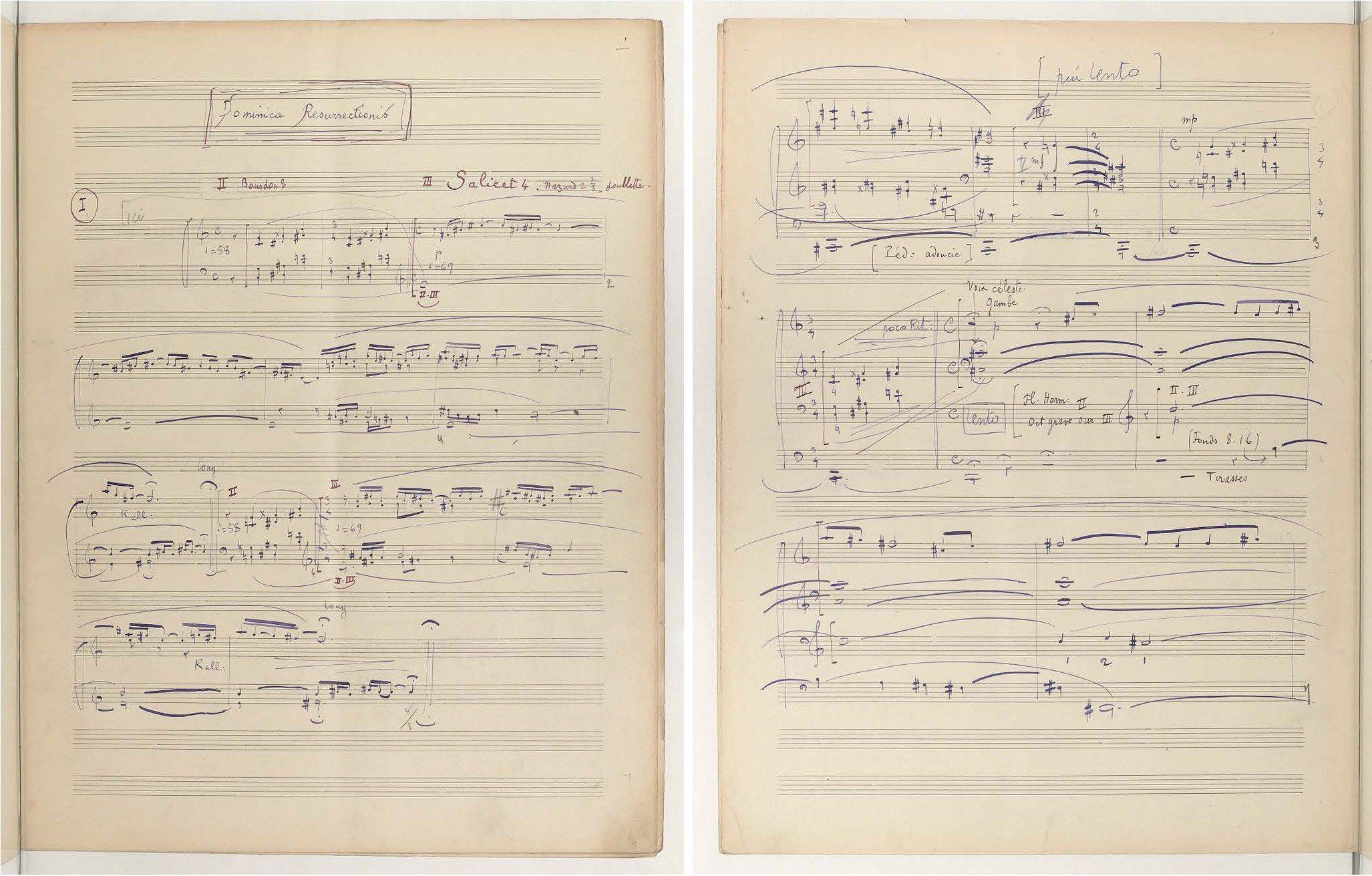
The opening page of the Prélude à l’introït for the Office of Easter [left] and the concluding moments of the Pièce terminale for the Office of Pentecost [right]. Here, Tournemire cites the opening phrase of the chant, Venite, exsultemus Domino (the opening two measures of the Easter Prélude à l’introït and the first and second lines of the Pentecost Pièce terminale), thereby musically framing the Cycle de Pâques with this Leitmotif chant.
Finally, one must understand that L’Orgue Mystique represents A Liturgical Year, not THE Liturgical Year. There are obvious gaps that make the performance of L’Orgue Mystique problematic if one were to perform it liturgically, even in settings where the Tridentine rite is not subject to episcopal proscription. In the French tradition, the organ falls silent during the proleptic seasons of Advent and Lent (with the exception of Gaudete and Lætare Sundays), which is common preferred praxis in this tradition, but is not parochially universal. Beyond the missing penitential Sundays, the work also omits the Third Sunday after Easter (whereupon the Feast of Saint Joseph is observed), along with the Second and Third Sundays after Pentecost, which are supplanted by Corpus Christi and the Feast of the Sacred Heart. Tournemire also omits the supernumerary Sundays of Epiphany and Pentecost, limiting the former to three and the latter to twenty-three, whereas most years exceed these numbers. So too, the cycle is missing the Annunciation, along with sundry Saints Days that may be traditions in parishes.
While these omissions may seem like liturgical blunders, one must not understand them as such. L’Orgue Mystique was never meant to be a definitive, all-encompassing, sine qua non musical liturgical rubric. Tournemire himself is not known to have used L’Orgue Mystique as a replacement for his liturgies. Indeed, he maintained his practice of improvisation with his Liber Usualis as his vade mecum in the organ loft rather than performing the work liturgically. He viewed L’Orgue Mystique as a testament to his beliefs—or as the critic Pierre Giriat (1886–1979) called the work, a “sonorous Summa Theologicæ”. [379]
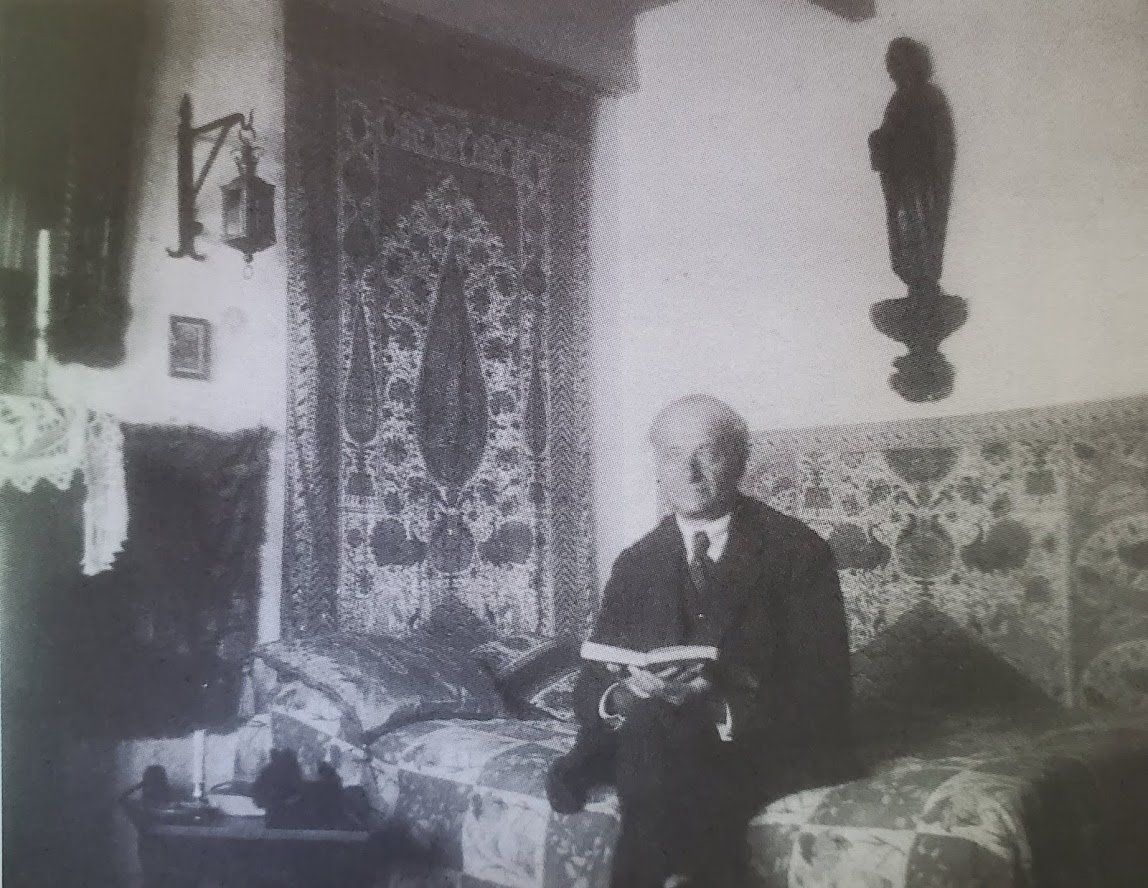
Charles Tournemire at his home on the Île d’Ouessant
A Musical Cynosure of Daunting Scope
L’Orgue Mystique set out to be a revolutionary guiding cynosure in the world of sacred music. Its foreboding duration and intellectual scope continue to intimidate organists even today; yet, through this one work, he sought to inspire a new movement in liturgical music, bringing organ music into modernity while still being rooted in the eternal traditions of the Church.
The mammoth proportions of this work made even the organ symphonies of Charles-Marie Widor (1844–1937) opuscules by comparison. Whether wittingly or by an accidental force of will, Tournemire would surpass the achievements of his musical forebearers and peers through L’Orgue Mystique both in theological substance as well as sheer scope.
However, the dissemination and performance of L’Orgue Mystique was one fraught with supervening obstacles. Composed between 1927 and 1932, the work came of age during the early phases of the Great Depression and the rise of Fascism. By the time of the work’s publication—which was delayed due to the economic collapse—Nazism haunted Europe, and many were well aware of the looming horrors to come. Two years later, Tournemire would be afflicted with cancer and, in 1939, would mysteriously die in the Bay of Arcachon, only to be forgotten as the world turned its attention to war.
Upon the publication of the last volume of L’Orgue Mystique in 1936, Tournemire wrote to the director of the publishing firm Heugel, Paul Bertrand (1873–1953), in gratitude and with heartfelt hope, coloured with a touch of sadness:
Perhaps neither you nor I, as an actual consequence of the social upheavals in this world, will witness the true triumph of my work; but be convinced, like myself, that one day they will arise, and these “Great Cycles of Love” will illuminate with a singular light, with brilliant rays. [378]
Perhaps Tournemire’s greatest frustration was the lack of performances of L’Orgue Mystique, with his harshest condemnation being reserved for his students—or, to be specific, one student in particular—Joseph Bonnet, to whom Tournemire dedicated five Offices—Christmas, Easter, Pentecost, Assumption, and All Saints. Tournemire rose to Bonnet’s challenge to create a work of “beauty [that] would assure a musical and liturgical unity.” However, L’Orgue Mystique seldom was performed by Bonnet (at least, in Tournemire’s perception)—and most certainly never in its entirety. In Tournemire’s Mémoires, we read:
Joseph Bonnet, organist of Saint-Eustache, made my acquaintance in Bordeaux, whence we are both from. He was only seventeen years old. From that age, he showed a surprising ardour and diligence with regard to the regular work of each day. Having no aptitude for the art of improvisation, he was later to confine himself to the field of execution and came to regard the “articulation of the fourth finger” as the centre of the world….
We know the magnificent results! For many years, he scrupulously took advantage of my advice; and, once emancipated, as it were, moreover (for he felt it to be his absolute right), he went through the salons, swaggering, proclaiming that his was a technique of his own invention, and if not being [igniting] powder, at least [he felt himself to be in the forefront] of modern organ technique….
The position at Saint-Eustache—he owes it to me; his first concerts were sponsored by me.
The final result: he turned his back on me!
As a Benedictine oblate, he certainly dishonours this corporation. . . .
I forgot to mention that he encouraged me (!) to write L’Orgue Mystique. In fact, he confessed to me, the day after the completion of this gigantic work, that he never thought that I would have had the power to see the project all the way through to the end.
His astonishment paralysed him so much so that his hands and feet automatically refused to pay homage to the twenty-five pieces of L’Orgue Mystique dedicated to him. [368–369]
Privately, Tournemire expressed his despair at his growing oblivescence in the consciousness of the musical world, as one can read in his Mémoires that, at the time, were devolving into a jeremiad:
Besides my dear daily hours of composition, life brings me disappointment: Men turn away from my work; it is the absolute of isolation. My former students—Duruflé, Bonnet, Bonnal, and many others—have no heart and no real intelligence. They are pushy, cold, and, moreover, “schemers”. Sad characters. [381]
Amen dico vobis and Fantaisie sur le Te Deum et Guirlandes alléluiatiques by Charles Tournemire
The Divine That Exists within, through, and beyond the Liturgical Year
As we approach the centenary of the completion of the first Office of L’Orgue Mystique in 2027, perhaps it is time that this work should be performed in one of the manners for which it was intended. It is a work that must be heard in extenso, and if the opportunity comes for one to hear it performed in this fashion, one should avail oneself of the opportunity, because it very likely will not readily happen again in one’s lifetime.
Of course, L’Orgue Mystique is to be seen liturgically and is to be performed liturgically, but it also stands above and beyond the liturgy as a grand meditation of Divine Truth, using the liturgy as the window to see the beauty beyond. It is a work of art—a monolithic human statement in the noblest sense—a liturgical symphony. Tournemire viewed the human masterpiece we know as the liturgy as a mountain upon whose craggy stones one can climb, ultimately to view the Beauty of God from the summit. L’Orgue Mystique—which is a supernal artistic expression derived from the liturgy—therefore, points to the Divine that exists within, through, and beyond the Liturgical Year—the Church’s annual ritualistic sanctification of time that stretches across the millennia, encapsulating the complexities of its faith and hope through the conjoining of oratory, oratorio, and orison.
Richard Spotts is the author of Charles Tournemire’s L’Orgue Mystique: La Haute Mission, published by the Leupold Foundation, from which the quotes in this article are cited.
Support the Tournemire Film Documentary
Learn how you can support the film documentary on Charles Tournemire produced by the award-winning Fugue State Films. This landmark project will feature scholars and performers from around the world as they delve into the fascinating life and times of Charles Tournemire and his musical masterpieces.