SUPPORT THE NEW TOURNEMIRE DOCUMENTARY
Produced by Fugue State Films.
Learn More Here
A Taste of Tournemire on Pipedreams

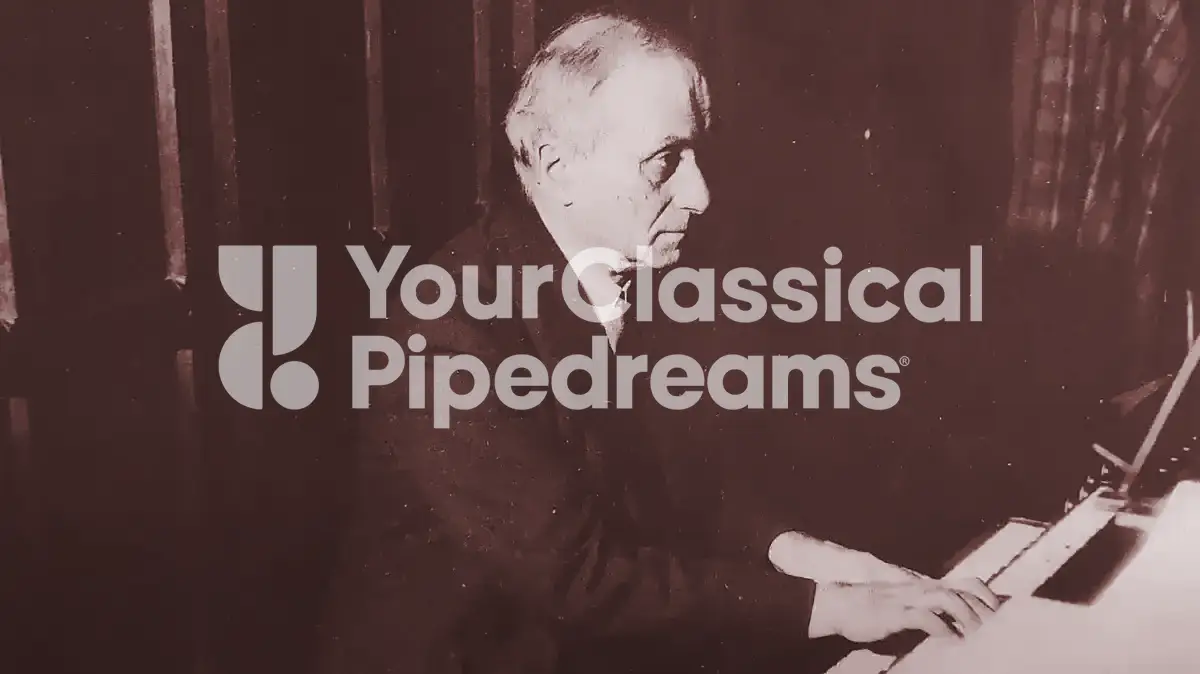
Pipedreams (Episode 2606)
An Invitation to Listen
In episode 2606 of Pipedreams, I had the opportunity to speak with Michael Barone about the music—and the larger vision—of Charles Tournemire, one of the most prolific yet enigmatic figures in the organ repertoire. The program offers only a glimpse, but it is a revealing one, and I’m grateful for the chance to share this music with a wider audience.
You can listen to the full episode here:
What the program explores—briefly, but meaningfully—is not just a composer or a collection of works, but a way of thinking about music itself.
Hear a 1-minute preview:
Courtesy of American Public Media, MPR

Some topics we cover:
The Liturgical Year as a Symphony
At the centre of the discussion is L’Orgue Mystique, Tournemire’s vast cycle of organ music written to accompany the Sundays and feasts of the liturgical year. Rather than treating each piece as a standalone work, Tournemire understood the entire year as a single, unfolding structure—something closer to a symphony than a catalogue.
Each suite is informed by the liturgical calendar and by Gregorian chant, with each movement written to serve a specific moment in the Mass. The music does not exist to showcase the composer or the performer, but rather it seeks to sonorously serve the ritual and the moment it inhabits.
That orientation alone places L’Orgue Mystique outside many modern delimiting paradigmatic expectations. It asks the listener—and the organist—to hear music as something functional, responsive, and cumulative, rather than Théophile Gautier’s l’art pour l’art.
Music as Theological Communication
Tournemire’s music is best understood as a form of theological communication: sound organised to convey meaning that words cannot fully contain.
In this sense, L’Orgue Mystique functions almost as metaphysical architecture. Harmony, colour, rhythm, and form are used not simply to express feeling, but to summon attention toward that which is beyond the immediate and the personal. The music does not give rise to casual insouciance, but rather it subtly elicits adumbral images of the Divine in a manner that haunts the soul.
This is one reason the work can feel elusive at first hearing. It resists spectacle. It unfolds on its own terms.
A Vision Shaped by History
Tournemire’s voice did not emerge in isolation. His early music is rooted in the late-nineteenth-century French Romantic tradition of the Belle Époque, where beauty was meaning. But the world changed, and so did his music.
After World War I, and under the influence of post-Enlightenment thought and Symbolism, his work grew more philosophical and more complex. Harmony becomes less conventional and more searching. Musical time stretches. Sound is infused with meaning.
At that point, the music ceases to be its own meaning and begins to look for it.
This evolution is part of what makes Tournemire so significant—not only as a historical figure, but as a bridge between traditions. Through him, we can trace a line from late Romanticism into the spiritual and intellectual concerns that shape much of twentieth-century avant-garde sacred music.
A Doorway to a Musical World
This Pipedreams episode does not attempt to explain everything. That would not be possible. Instead, it offers a doorway: a chance to hear selections of the music, to encounter its intentions, and to consider new ways of listening.
If you are curious about how music can serve time, ritual, and meaning, I hope you’ll listen.
Summary: Pipedreams host Michael Barone and Tournemire specialist Richard Spotts reflect upon one of the most comprehensive collections of organ music for the Roman Catholic Church, Charles Tournemire’s L’Orgue Mystique, in anticipation of Spotts’ 2026 Complete Performance of L’Orgue Mystique at Saint Paul’s Episcopal Church in Chestnut Hill, Philadelphia.
Pipedreams Episode 2606: A Taste of Tournemire
Hour One
XLIV. Dominica XVII post Pentecosten: [Prélude à l’introït] “Justus es, Domine”
Jacques Boucher at the Basilique Notre-Dame de Montréal, Québec [Casavant (1927) and Guilbault-Thérien (1985)]: REM 31131
XVIII. Quasimodo: Dominica I post Pascha: [Pièce terminale] “Toccata sur un choral”
Georges Delvallée at the Abbaye Saint-Ouen de Rouen, France [Cavaillé-Coll (1890)]: Accord 476 1059
XIII. Dominica in Sexagesima: [Offertoire] “Perfice gressus meos”
Georges Delvallée at the Basilique Sainte-Clotilde, Paris [Cavaillé-Coll (1859) and Beuchet (1962)]: Arion 268 104
XLII. Nativitas Beatæ Mariæ Virginis: [Offertoire] “Beata es, Virgo Maria” and [Pièce terminale] “Prélude et louanges”
Georges Delvallée at Notre-Dame-la-Dalbade, Toulouse [Puget (1888)]: Accord 476 1059
VII. Epiphania Domini: [Offertoire] “Reges Tharsis et insulæ”, [Communion] “Vidimus stellam ejus in Oriente”, and [Pièce terminale] “Fantaisie”
André Marchal at Setnor Auditorium, Crouse Hall, Syracuse University, Syracuse, New York [Holtkamp (1950)]: Westminster 14130
Hour Two
“Petite Rhapsodie Improvisée”
Charles Tournemire at the Basilique Sainte-Clotilde, Paris, France (recorded 1931) [Cavaillé-Coll (1859)]: Arbiter 156
“Sortie” from “L’Orgue Moderne” [Volume 1]
Aaron Tan at the Cathedral of the Sacred Heart, Richmond, Virginia [Juget-Sinclair (2004)]: Raven 208
“Piece symphonique”
Michelle Leclere at the Iglesia de San Vicente Mártir, San Sebastián, Spain [Cavaillé-Coll (1868)]: Aeolus 10291
XXVI. In Festo Sanctæ Trinitatis: [Pièce terminale] “Triptyque”
Georges Delvallée at the Basilique Saint-Sernin de Toulouse, France [Cavaillé-Coll (1889)]: Arion 268105
XXXVI. Dominica X post Pentecosten: [Communion] “Acceptabis sacrificium justitiæ”
Adrian Gunning at Coventry Cathedral, England [Harrison (1962)]: Libra 155
VI. Sanctissimi Nominis Jesu [Communion] “Omnes gentes”
Sandro Müller at the Liebfrauekirche, Bottrop-Eigen, Germany [Seifert (1929) and Weyland (1939)]: Cybele 050 106
XLVIII. Festum Omnium Sanctorum [Pièce terminale] “Choral”
Kathrine Handford at the Basilica of Saint Mary, Minneapolis, Minnesota [Wicks (1949)]: Sonus-Luxque 105
Support the Tournemire Film Documentary
Learn how you can support the film documentary on Charles Tournemire produced by the award-winning Fugue State Films. This landmark project will feature scholars and performers from around the world as they delve into the fascinating life and times of Charles Tournemire and his musical masterpieces.