SUPPORT THE NEW TOURNEMIRE DOCUMENTARY
Produced by Fugue State Films.
Learn More Here
7: The Ageing Tournemire


After this period of personal tragedy, Tournemire voraciously busied himself with some of his most profound musical output, climaxing in 1927 when he began perhaps his greatest work, the landmark L’Orgue Mystique. Written in the context of the interbellum renouveau catholique, this colossal cycle, consisting of fifty-one Offices, each with five liturgical movements to be performed during the Mass, is often credited with being the Catholic equivalent of the Lutheran Cantatas of Bach. Indeed, this mammoth fifteen-hour-long opus alone exceeds in duration Bach’s entire collected organ works. Yet, despite the noble grandeur and profundity of his achievements, his endeavours, which invariably were intellectually and spiritually recherché, continued to be disregarded by a culture with more plebeian sensibilities, causing the discomfited Tournemire to repine, “I did not intend to create a museum.”
In his dotage, Tournemire’s mercurially emotive nature (a personality trait common to those from Bordeaux) could transform into explosive irascibility, especially when piqued by the braggadocio of his more acclaimed, immodest, meretricious, and philosophically nescient colleagues. His feelings of estrangement only increased after he remarried in 1934 to the young, besotted Alice Espir, whose protective (if not possessive) adoration exasperated the situation. Of Tournemire’s perceived enigmatic froideur, the organist Daniel-Lesur insightfully noted:
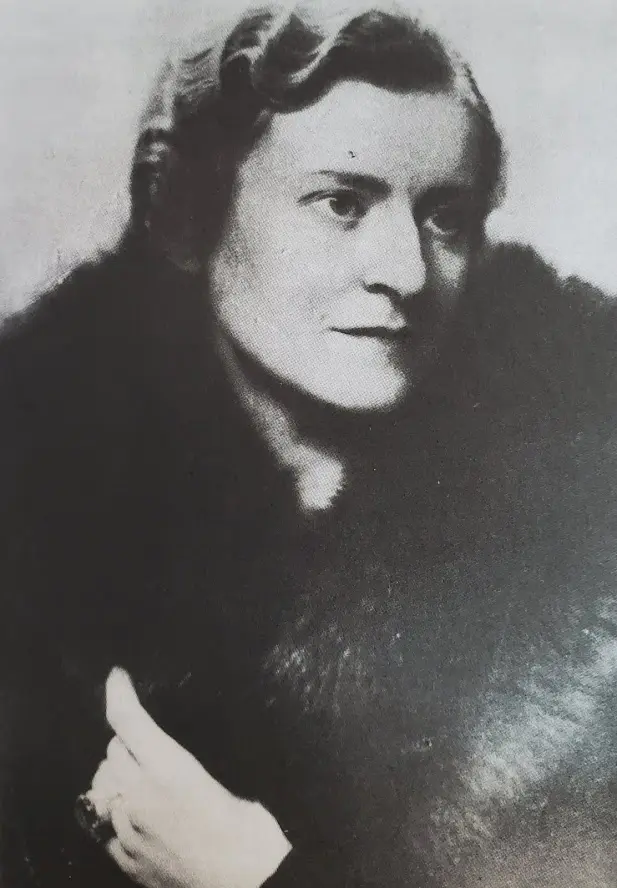
Alice Tournemire née Espir
In him, the man and the artist were one and the same: Of noble character, he remained aloof from all kinds of intrigue, and if he suffered deeply from being ignored by his peers, he was entirely aware of his worth. He could be difficult. Relaxed, Tournemire let a more familiar aspect of his personality appear, most often good-natured, occasionally not so good-natured, always spontaneous. Endowed with a highly emotional nature, it was not rare to see him go in several instants from calm to the most vehement indignation. One sensed that he held to an absolute value: grandeur. The eclectic, along with the dilettante, were, without doubt, intellectual attitudes in direct contradiction to his temperament. His love of nature was intense. Each year saw him carry back from his retreat on the Île d’Ouessant one or another new chef-d’œuvre, pondered while facing the ocean. The ocean’s presence marked his character with a sense of universal grandeur. The ocean and the cathedrals.
On the third of September 1939, war with Germany was again declared. The “just and lasting peace” proclaimed after the Great War had merely created the justification for a new and even greater war. During the psychologically tense preamble to hostilities known as the drôle de guerre, Sainte-Clotilde was closed due to the threat of bombardment, citing its proximity to the French War Ministry, moving to a small chapel on rue La Cases.
Bereft of an organ and his cherished Sainte-Clotilde, Tournemire and his wife retreated to his sister’s cottage in the coastal village of Arcachon, and it was there that the unthinkable happened. Tournemire left the house on the thirty-first of October 1939, only to be found by an oyster farmer drowned in the Bassin d’Arcachon four days later. Due to the chaos caused by the onset of the war, his body was hastily buried with little note.
The mystery surrounding his shocking and shadowy demise and abrupt interment sans the obsequies only fitting for a man of such dedicated faith has ignited rampant rumour and intrigue with pervasive mutterings suggesting suicide. Though vehemently condemned by Tournemire’s disciples as incongruous with his famed piety, there is an unuttered, dolorous acknowledgement of another possibility: The imminent probable fall of France to Nazism, the personal loss of his precious Saint-Clotilde, his career rife with discomfiture and the sense of perfidy he felt from those whom he had trusted, increasing financial woes that threatened the loss of his home in Paris, his life-long pensive and melancholic emotional sensitivity, and a diagnosis of prostate cancer that resulted in a surgery that rendered him gravely enfeebled—Collectively these all may well have led to the collapse of his spirit. It was as though the vicious world had said to Tournemire that it was time, and in the shadow of All Souls’ Day, looking to his beloved oceanic source of wisdom and peace, he yielded himself to its pelagic embrace.
Video: Reminiscences of Mme Alice Tournemire of her husband Charles Tournemire