SUPPORT THE NEW TOURNEMIRE DOCUMENTARY
Produced by Fugue State Films.
Learn More Here
6: A Period of Losses

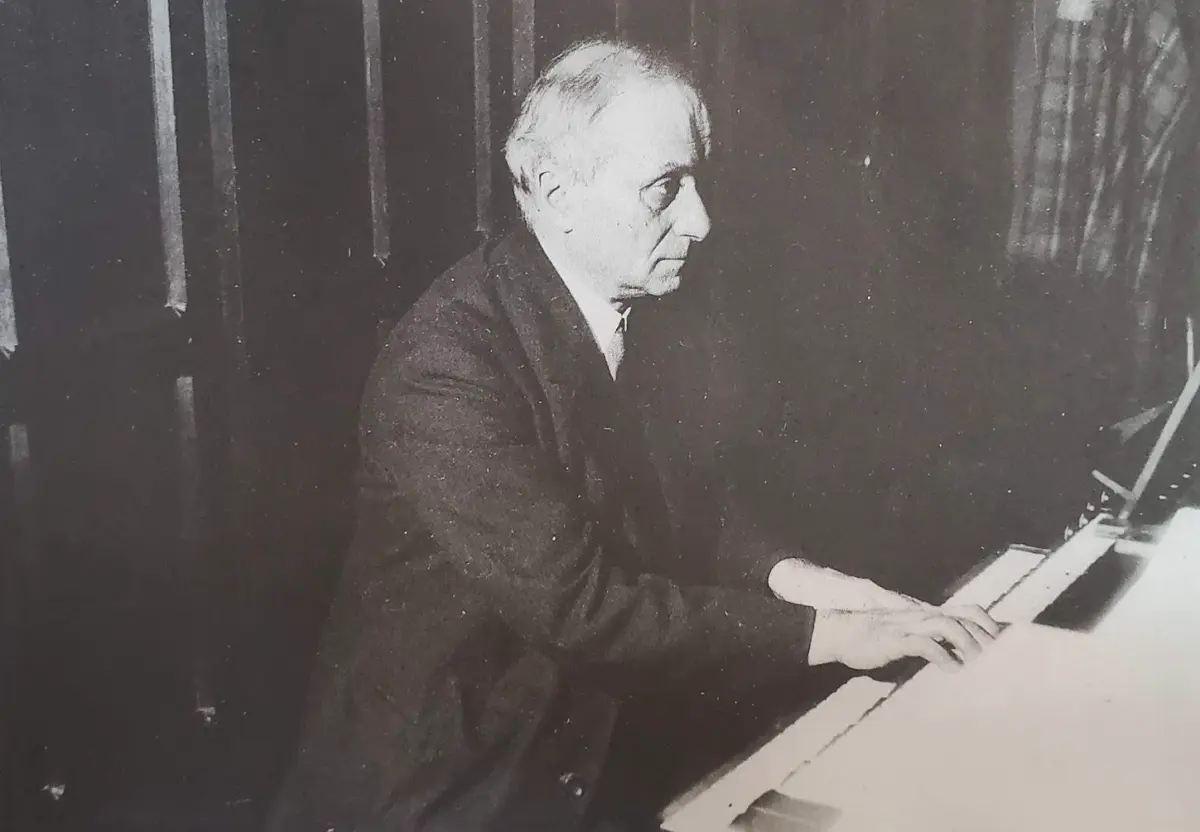
Tournemire’s antebellum period (1898–1914) was a happy one fecund with success. In addition to acquiring the post at Sainte-Clotilde and his marriage to Alice Taylor, his musical output included his first five orchestral symphonies, and his cantata Le Sang de la Sirène, which won the Concours musicale de las Ville de Paris in 1904—but then the lamps went out all over Europe.
With the Great War (1914–1918), the Romantic ideals that propelled society through the nineteenth century reached an inexorable, calamitous end, bringing a cultural shift in music and marking the beginning of a period of deep personal despondency for Tournemire. As he grew in years, Tournemire’s Post-Romantic harmonic language initially entered into Impressionism but later moved toward a chromatic polymodality.

Tournemire and His First Wife, Alice Taylor
Notwithstanding his modern proclivities, he became out of step with the disillusioned nihilism of the génération perdue, whose avant-garde music then in vogue (epitomised by Igor Stravinsky and Les Six) was a wanton iconoclastic reaction against Romanticism and Impressionism. This cultural and æsthetic shift resulted in Tournemire’s music being buffeted with harsh criticism or, at best, damning praise. In 1925, the critic Émile Vuillermoz lamented that “Tournemire’s vast compositions [would not destine him for] great success among the crowds.” Later, noting the same qualities in his organ music, the organist Flor Peeters, who nonetheless was a great supporter of Tournemire, remarked:
Tournemire’s organ music speaks to an intelligent, spiritually-oriented listener, in short, to an élite. By contrast, Vierne’s organ music, with its simple lines and wonderful effects, addresses itself to a larger audience.
In 1919, Tournemire was granted the Ensemble Class professorship at the Conservatoire, but this was simply believed to be a stepping-stone, for he was generally accepted as the Professor of Organ presumptive heir-apparent in continuance of the lineage of his Maître Franck. The organist Eugène Gigout (who had succeeded Widor) had taken on the position emphasising improvisation and chant accompaniment, so Tournemire was seen as destined to carry the baton into the future; however, through the machinations of Tournemire’s nemesis Widor, he was glossed over for Widor’s protégé Marcel Dupré, who, through his well-cultivated performance-oriented career and prodigious cult-following, stole Tournemire’s perceived birthright. However, Tournemire’s sense of personal anguish caused by this criticism and rejection in the shadow of those who basked in societal éclat paled in comparison to the tragic loss of his loving wife Alice in May of 1920, which launched in him a disconsolate period of profound and haunting darkness.
Video: Poème nº II from the “Trois Poèmes pour orgue” by Charles Tournemire