SUPPORT THE NEW TOURNEMIRE DOCUMENTARY
Produced by Fugue State Films.
Learn More Here
2: The Rise of Franckianism


The music of Tournemire and the mysticism expressed through his art did not manifest itself ex nihilo but is part of a greater metanarrative that begins with the theodicy of the Gallican Church as secular society grappled with dramatic political upheaval and as the Church struggled for survival and integrity within a disquieted and reactionary culture. Born of the Enlightenment, the demagogues of the French Revolution, viewing the Church with implacable antipathy, sought to abrogate its existence. The fall of the Ancien régime in 1789 and the resulting chaos of la Terreur saw the predation of the great churches of France and the imprisonment or martyrdom of recusant clergy (the abjuring priests being those who obsequiously renounced Christianity in favour of the Deist Culte de l’Être Suprême). Even the reordering of the calendar into décades sought to suppress the hebdomadal celebration of the Sabbath. Until a tenuous rapprochement was reached via the Napoleonic Concordat of 1801, the Church lay in a moribund state, and naturally, the vocation of organist well-nigh tumbled into oblivion. Eventually rising from the ashes, the Church’s recrudescence during the Bourbon Restoration and Second Empire periods saw the emergence of the monumental instruments of the organ-builder Aristide Cavaillé-Coll. Yet, still, sacred music at this time fell victim to the prevailing bourgeois theatrical indulgences of Romanticism. Men like Louis-James-Alfred Lefébure-Wély typified the cloyingly melodramatic organ-playing of the epoch with his specialisation in storm scenes, insipidly gooey sentimentalism, and in the use of overtly secular operatic melodies, or as the musicologist Norbert Dufourcq described this liturgical nadir: “the epitome of banality, triviality, and the style de salon.”
Then, in 1870, the French Second Empire collapsed in the wake of the Franco-Prussian War and the concomitant catastrophic Paris Commune of 1871. The nation, ensanguined from this tumult, paused and engaged in serious ruminations, and as a result, a new generation of artists emerged. Widor, who at that time would assume the role of provisional organist at Saint-Sulpice in Paris (a position he held for sixty-four years), came to embody the sense of gravitas of the new Third Republic with his classical ideals of maturity, nobility, and elegance, eschewing the theatrical frivolity of the Bourbon Restoration and Second Empire periods.
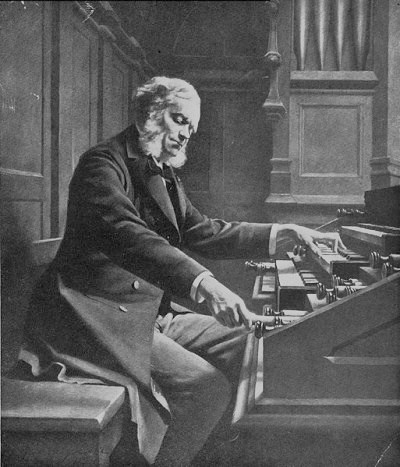
Cesar Frank at Sainte-Clotilde:
Nonetheless, despite elevating the tone of the Catholic Mass, musical grandeur rather than religiosity reigned in the court of Le Roi des organistes français, but upon the reopening of the Conservatoire after the chaos of the Paris Commune, a countervailing prophetic voice resounded to challenge the opprobrious state of affairs. That still small voice who would espouse a more spiritually cultivated vision was the newly-appointed professor, the organist from Liège, César Franck. Franck’s predecessor, François Benoist, had led his organ students in a thoroughly unremarkable direction, and it was felt by the Conservatoire that Franck’s appointment would be equally inconsequential. They could not have been more mistaken. Inculcating his students to heed the great Virtues of their vocation, of Franck’s pious artistry, Gustave Derepas wrote:
César Franck’s mysticism is the direct expression of the soul and leaves him his full consciousness in his aspirations toward the Divine…. This music, which is truly as much the sister of prayer as of poetry, does not weaken or enervate us, but rather restores to the soul, now led back to its first Source, the grateful waters of emotion, of light, of impulse; it leads back to heaven and to the City of Rest.
Archbishop Darboy (who later was to be assassinated during the Commune) is said to have remarked of Franck to Sainte-Clotilde’s priest, “You have there a marvellous intercessor, my son; he will win souls to God more than we can.” Despite such esteemed sacerdotal accolades, ultimately the more socially acceptable Widor, who adeptly navigated within the upper echelons of the Parisian haut monde, held popular preëminence, while the dowdy, foreign-born Franck suffered baleful indignation in the hands of the secular and xenophobic establishment. To the horror of Franck’s devoted students who held their Maître in hagiographic awe (a coterie later to be known as the Bande à Franck), the vast majority of the Conservatoire faculty quietly boycotted the funeral of the Pater Seraphicus as a subtle and vindictive expression of animus.
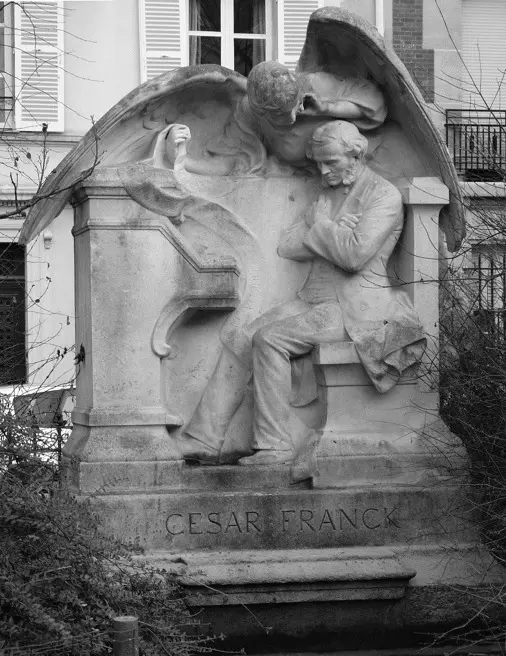
Frank monument at Sainte-Clotilde
Video: Choral by Charles Tournemire