SUPPORT THE NEW TOURNEMIRE DOCUMENTARY
Produced by Fugue State Films.
Learn More Here
1: Tournemire, the Early Years

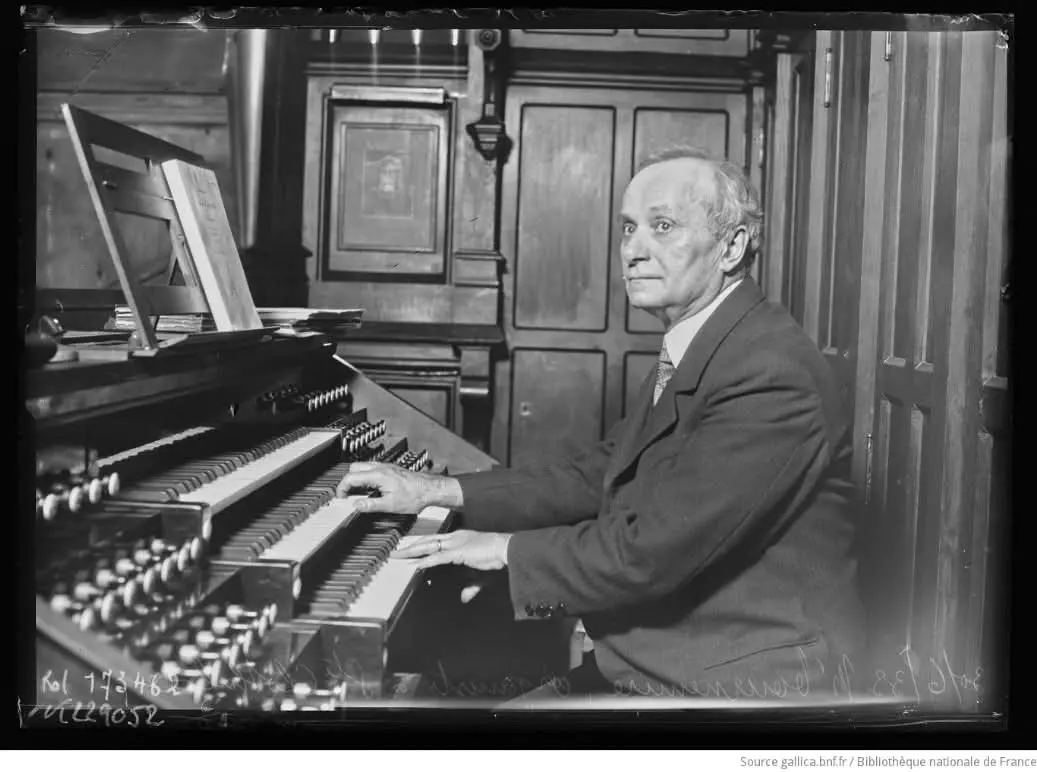
Charles Tournemire was a brilliant but now largely forgotten musical Titan who, through his genius, created a seminal corpus of works for organ of supernal mystical transcendence that rightly ought to be lauded by each passing generation.
Born in Bordeaux on the twenty-second of January 1870, Tournemire began his musical career as a precocious child-organist at the church of Saint-Pierre. In 1886, he moved to Paris to study composition and to privately study piano. Tournemire’s nascent talent led him to the Conservatoire de Paris, where he studied organ under the tutelage of César Franck, the renowned organiste titulaire of the Basilica of Sainte-Clotilde. Indeed, to understand the heart of Charles Tournemire, one must look ad fontes to the love he held for his great pious Maître:
One never departed from the Seraphic Musician feeling discouraged; his comments, said in a few words, generally gentle, incisive, and salient, brightened the soul and warmed the heart. This “experience” made his pupils smile. How many times, for our part, did we not hear him say: “Try to find yourself…. Years will be necessary….” The goodness of César Franck was immeasurable. If he lived for transcendent art, he knew, nevertheless how to interest himself with the life of those who came to him. He possessed, to an outstanding degree, the intelligence of the heart.
Through Franck, Tournemire experienced a metanoia—a new awareness of Transcendence and a vocational awakening. Exuding an ineffable sapience and a nurturing spirit, and referred to by his students as Pater Seraphicus (the moniker of Saint Francis of Assisi), Franck’s heuristic pedagogical approach had a compositional and improvisational emphasis; but more importantly, he sought to create not simply organists but artists, imploring his students to seek the Soul of Music.
Then, in the spring of 1890, tragedy struck: While riding in a carriage through the streets of Paris, Franck’s cab collided with a horse-drawn omnibus. Although the injuries he sustained seemed innocuous at the time, they proved gravely deleterious, resulting in Pleurisy complicated by Pericarditis, eventuating in his death on the eighth of November 1890. In and of itself, Franck’s passing was exceedingly traumatic to the young Tournemire; yet to add to his grief, Franck’s successor, Charles-Marie Widor (the fêted organist of Saint-Sulpice in Paris known by the epithet Le Roi des organistes français), compounded Tournemire’s misery. Widor’s relationship with Tournemire could, at best, be termed frigid, the grieving pupil feeling Le Roi des organistes français to be an abysmal replacement for the Pater Seraphicus. Widor’s rigid, formulaic style rooted in Classical pedantry, his emphasis on technique over artistic exploration, along with Widor’s cold demeanour and open denigration of his Maître Franck, horrified Tournemire. Louis Vierne, Tournemire’s fellow student (later to become organist at Notre-Dame in Paris), vividly remembered Widor’s opening remarks upon his succession to the post: “In France, we greatly favour improvisation over execution. This is more than a mistake. It is nonsense!” From the onset, Widor condemned Tournemire’s improvisatory style as mere “aquatic music.” Having neglected to do proper obeisance to Le Roi, Tournemire would recollect that there was “a chill that degenerated on the part of Charles-Marie Widor into a profound and absurdly enduring hatred with regard to me”—a hatred that would come to haunt Tournemire later in life. Rising above the odium, however, Tournemire was able to use the principles Widor fostered (or, as Tournemire termed it, Widor’s technique formidable) to his advantage, winning the Premier prix d’orgue in 1891 and acquiring the coveted organ bench of Sainte-Clotilde from Gabriel Pierné in 1898, despite Widor’s attempt to undermine his appointment. It was there, from that tribune, that Tournemire would then be blessed to remain in the edifying spiritual presence of his Maître for the rest of his days.
Video: L’Orgue Mystique: Ann Labounsky Interview (Full Version)