SUPPORT THE NEW TOURNEMIRE DOCUMENTARY
Produced by Fugue State Films.
Learn More Here
5: Josephin “Sâr” Péladan

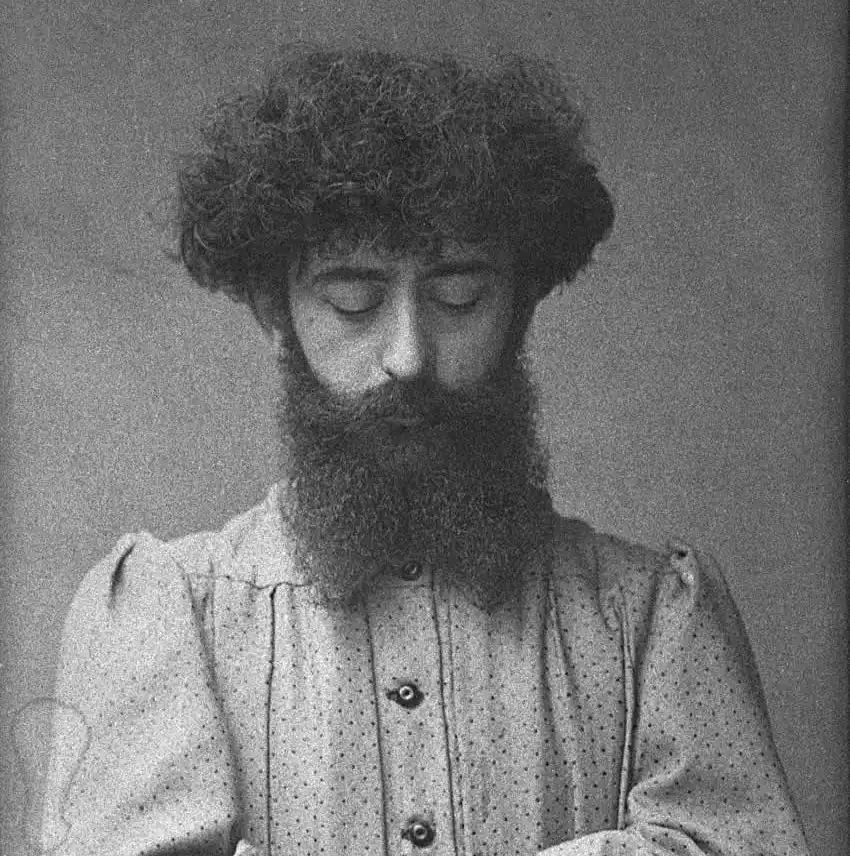
The vicissitudes endured by the Church and the appeals within the institution for musical integrity proved highly formative upon Tournemire, but then, in 1903, he married Alice Taylor, through whom he would have his initial foray into mysticism. Her sister was the wife of Josephin “Sâr” Péladan, a French mystic and founder of the Ordre de Rose ✠ Croix in Paris. In the 1890s, Péladan famously hosted salons promoting the literary, visual, and musical art of the Symbolists, a movement that emerged during the fin de siècle that sought to capture the noumenal through allegorical abstraction. In his article L’esthetique au salon de 1883, Péladan defined his vision of art:
Art is man’s effort to realise the Ideal, to form and represent the supreme Idea, the Idea par excellence, the abstract Idea. Great artists are religious because to materialise the Idea of God, the Idea of an angel, the Idea of the Virgin Mother requires an incomparable psychic effort and procedure. Making the invisible visible: that is the true purpose of art and its only reason for existence.

As the poet Stéphane Mallarmé argued, the nodus of Truth cannot be copied but can only be pointed to, saying that “the ideal is to suggest the object. It is the perfect use of this mystery that constitutes the symbol. An object must be gradually evoked in order to show a state of soul.” As his philosophies ossified, Tournemire found himself in concord with this artistic raison d’être, espousing the Symbolist epistemology, where one sees through the glass dimly via allegorical adumbrations of artistic simulacrum. Tournemire became a passionate follower of the works of Joris-Karl Huysmans, Ernest Hello, and Leon Bloy, and in 1922, upon the death of Saint-Saëns, Tournemire was awarded the music chair of the Société Baudelaire, thus further exposing him to the eminent artists and philosophers of the day.
Tournemire’s Faith was not a simple a priori assertion; but through scholarly erudition rooted in philosophia perennis, he excogitated a religiously pansophical teleological dialectic—a theosophical eschatology wherein, having “glimpsed the harmony and flow of things spiritual,” he perceived that God through Xrist, “crucified out of love of the Good,” constituted an ultimate apotheosis. Through this esotericism, he sought to sonorously elicit the noumenal ontological and broader metaphysical Truths of the Church through the mystically illuminating wisdom of music. Armed with these rarefied insights, he would withdraw to his summer cottage on the Île d’Ouessant off the coast of Brittany, on whose property was situated a moulin that he had furnished with a music atelier. There, he found his compositional muse where, in the serenity of that halcyon hermitage, he would “look to the sea for answers.”
Music to Tournemire was not a mere métier. Being a man of humble disposition and intellectual acuity and with a profound entelechial vocational awareness, the nihilism endemic in the secular sphere and the irksome hubris of its musicians were anathemas to Tournemire, who, through religious and philosophical cognisance, descried the realm of transcendent, immutable Verities. He averred a latreutic musical axiology, opining philosophically facile temporal music as worthless, famously proclaiming organ music where God is absent is a body without a soul. In his unpublished treatise, De la haute mission de l’organiste à l’église, Tournemire invoked the words of Hello: “Higher than reason, orthodox mysticism sees, hears, touches, and feels that which reason is incapable of seeing, hearing, touching, and feeling”; and in his biography of Franck—an honorific didactic paean dedicated to his Maître written while composing L’Orgue Mystique—he pronounced:
Did not Ernest Hello—the Franck of literature, as Henri Duparc called him—also have a very clear understanding of his own worth when he exclaimed: “I would like to know glory.” He was thinking about the glory to which a gifted, prayerful, and humble writer has the right… Glory, which is to say, “a call which has been heard by souls and is bearing fruit; a call which invariably leads to the praise of the One who saved the world.”
Video: Princeton After Noon Organ Recital, Spring 2020